


The Age of Data and the Statistical Imperative
Nowadays, scientific research and academic studies, especially at the master's and doctoral levels, rely heavily on collecting and analyzing massive amounts of data. It is no longer limited to proposing hypotheses, but requires proving or disproving them with conclusive digital evidence. This is where the importance of SPSS statistical analysis As an indispensable tool for every researcher who seeks to excel and make a real contribution to their field.
Researchers andGraduate students in Saudi Arabia وEmirates They face a double challenge: Adhering to the strict academic standards imposed by prestigious universities such as King Saud University, King Abdulaziz University, and the United Arab Emirates University, in addition to the need to produce high-quality research that can be published in peer-reviewed scientific journals. This requires mastery of statistical analysis tools, primarily the SPSS program.
This comprehensive guide, provided by Science Club Academyis your gateway to understanding and mastering SPSS, from its basics to its advanced techniques, with an emphasis on practical applications that serve the needs of scientific research in the region.
1. What is SPSS and why is it the first choice for researchers?
SPSS, an acronym for Statistical Package for the Social Sciences (Statistical Package for the Social Sciences) is an integrated software system designed by IBM specifically to perform all kinds of statistical analyses. Although its original name refers to the social sciences, its use has expanded to broad fields such as medicine, economics, business, education, and engineering.
1.1. A short historical journey
SPSS was first developed in 1968, and since then, it has gone through many developments to become the most popular statistical tool in academia around the world. Its ease of use, intuitive graphical interface, and ability to handle large datasets have made it the preferred choice for researchers who may not be deeply specialized in statistics.
1.2. Competitive Advantages of SPSS
Feature | Description and importance to the researcher |
Ease of use (GUI) | A simple graphical interface that enables the researcher to perform complex analyses in a few clicks, without the need to write code. |
Statistical comprehensiveness | The program covers all statistical tests, from simple descriptive (means and deviations) to advanced inferential (regression, path analysis). |
Effective data management | It provides powerful tools for cleaning data, recoding variables, and creating new variables, ensuring accurate analysis. |
Output quality | Provides clear and detailed results in professional tables and graphs, ready for direct inclusion in master's and doctoral theses. |
Academic compatibility | The program is considered the basic standard for statistical analysis in most Arab and international universities, ensuring the acceptance of the statistical methodology of the research. |
2. The basic structure of the SPSS program: Two main windows
To understand how SPSS works, a researcher must understand that the program basically consists of three main windows that work together:
2.1. Data Editor window
This is the window where data is entered and variables are defined. It is divided into two main screens:
A. Data View
This is where the numeric values of the data are entered. Each row represents a case (such as a respondent in a survey), and each column represents a variable (such as age, gender, or answer to a specific question).
B. Variable View
This screen is the heart of the data preparation process. It is where the properties of each variable are precisely defined, including:
•Name: A short name for the variable.
•Type: Data type (numeric, text, date).
•Label: A full description of the variable (e.g., “degree of satisfaction with service quality”).
•Values: Define the numeric coding of text values (e.g., 1=strongly agree, 5=strongly disagree).
•Measure: Specify the type of statistical measure (nominal, ordinal, categorical/relative). This part is vital because it determines what type of statistical tests are allowed.
2.2. Output Viewer
This window shows all the results of the statistical analyses performed by the researcher, as well as graphs and tables. It is very important that the researcher learns how to read and interpret these outputs, not just copy and paste them.
2.3. Syntax Editor window - Pro
Although the graphical interface is sufficient for most analyses, advanced researchers use the Syntax window to write code directly. This ensures reproducibility and makes it easier to perform complex or repeated analyses on different datasets.
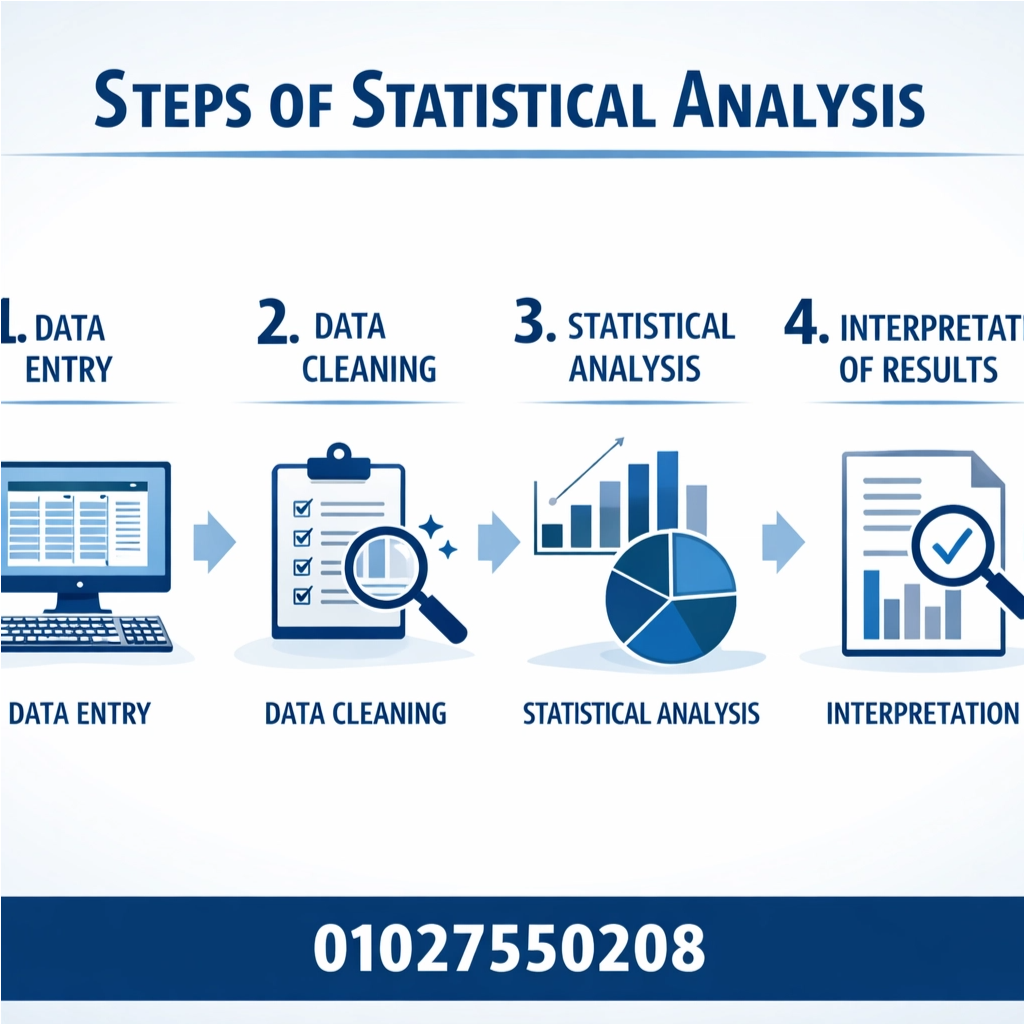
3. Methodological steps for statistical analysis using SPSS
Statistical analysis is not a random process, but an organized approach that ensures that the results are accurate and reliable. Researchers typically follow the following steps:
3.1. Step one: Data Preparation and Cleaning
This step is the most important of all, as “Garbage In, Garbage Out”.
A. Data entry and definition
As mentioned, data is entered in the Data View window and precisely defined in the Variable View. You must ensure that all variables are properly coded and their measures are precisely defined.
B. Checking Missing Values
The cause of the missing data (is it random or systematic?) must be identified and dealt with by appropriate statistical methods (such as replacing the average or using advanced techniques such as Multiple Imputation).
c. Detecting Outliers
Outliers are data points that deviate significantly from the rest of the data and can negatively affect the results of statistical tests. Researchers use tools such as boxplots or the Z-Score to identify them and deal with them by either correcting or excluding them (with academic justification).
3.2. Second Step: Descriptive Statistics
Before moving on to hypothesis testing, the researcher must describe the characteristics of the sample and the data collected. This gives the reader a clear picture of the nature of the data.
Statistical scale | Description | SPSS function |
Measures of centralization | Mean, Median, Median, Mode. | Know the typical or centralized value of the data. |
Dispersion scales | Standard Deviation, Range, and Variance. | Measures how far or close the data is to the mean. |
Shape scales | Skewness, Kurtosis. | Determine the shape of the data distribution (is it a normal distribution?). |
Frequencies and percentages | Distribution of sample members according to demographic variables (gender, age, educational level). | Accurately describe the characteristics of the sample. |
3.3. Step three: Inferential Statistics and Hypothesis Testing
This is where the most important part begins, using statistics to infer the characteristics of a population based on sample data, and to test research hypotheses. The choice of test depends on the type of variables (quantitative or qualitative) and the number of groups to be compared.
A. Comparison Tests
•T-Test: It is used to compare the average of two groups (such as comparing male and female performance).
•Analysis of variance (ANOVA): It is used to compare the average of three or more groups (such as comparing the performance of students from three different universities).
B. Relationship Tests
•Correlation coefficient: It is used to measure the strength and direction of the relationship between two variables (such as the relationship between study hours and academic achievement).
•Regression Analysis: It is used to predict the value of a dependent variable based on one or more independent variables.
4. Advanced statistical analysis: Beyond the basics
To produce high-impact doctoral or advanced research, researchers often need to go beyond basic tests and use more complex statistical techniques.
4.1. Factor Analysis
This analysis is used to reduce a large number of variables to a smaller number of underlying factors (Constructs). It is very necessary when constructing or validating measurement instruments (such as questionnaires).
4.2. Analysis of Multiple Variance (MANOVA)
It is used when a researcher has more than one quantitative dependent variable and wants to compare the effect of one or more independent variables on these dependent variables combined.
4.3. Logistic Regression Analysis
It is used when the dependent variable is a binary variable (e.g., pass/fail, agree/disagree). This type of analysis is common in medical and economic research.
5. Regional context: SPSS at universities in Saudi Arabia and the UAE
The requirements for statistical analysis at leading universities in the region are rigorous and demanding.
5.1. Academic Quality Requirements
Supervisory and discussion committees at Saudi and Emirati universities (e.g. King Fahd University of Petroleum and Minerals, Zayed University, University of Sharjah) require the following:
1.Adhere to the hypotheses of the tests: The researcher must ensure that their data meets the statistical assumptions of each test (e.g., the assumption of normal distribution in parametric tests).
2.Deep interpretation of results: It is not enough to display tables, the results must be linked to theory and previous literature, and statistical and practical significance must be interpreted.
3.Use the latest versions: The latest version of SPSS is preferred to ensure accuracy and compliance with modern standards.
5.2. Common Challenges for Graduate Students
Challenge | Scientific Club Academy's proposed solution |
Difficulty choosing the right test | Provide specialized consultations to determine the optimal statistical test based on the nature of the data and hypotheses. |
Data cleaning issue | Help address missing and anomalous values to ensure data integrity prior to analysis. |
Interpreting complex outputs | Provide detailed analytical reports explaining each table and graph, linking them to the research objectives. |
Lack of time before the discussion | Provide fast and accurate statistical analysis service to meet deadlines. |
8. Conclusion and next steps
It has become SPSS statistical analysis It is the lingua franca of rigorous scientific research. Mastering this tool opens doors to scientific publication and academic success. Whether you are Graduate student in Saudi Arabia Or Researcher in the UAEInvesting in the quality of your statistical analysis is an investment in your career.
Don't let the complexities of statistics hold you back. Reach out to the experts at Science Club Academy Today, let us help you turn your data into a scientific success story.
4. Deep dive into inferential statistics: A Practical Guide to Key Tests in SPSS
The essence of scientific research lies in testing hypotheses, turning theoretical questions into numerical conclusions supported by evidence. The SPSS program provides a wide range of statistical tests that meet all research needs. Here we will focus on the three most important tests that are essential for graduate research.
4.1. T-Test: Comparing averages accurately.
One of the most common and simple tests is the t-test, which is used to compare two means. The researcher must determine which type of t-test is appropriate for their hypothesis:
A. One-Sample T-Test
It is used to compare the average of a single sample to a previously known average or normative value (e.g. comparing the average score of master's students at a particular university to a known national average).
B. Independent Samples T-Test
It is used to compare the average of two very different groups (such as comparing the level of anxiety in males and females, or comparing the performance of two different training groups).
Implementation steps in SPSS:
1.from the list: Analyze -> Compare Means -> Independent-Samples T Test...
2.Enter the dependent (quantitative) variable in the Test Variable(s).
3.Enter the independent (dichotomous) variable in the Grouping Variable.
4.Identify the two groups (e.g., 1 for males, 2 for females) in Define Groups.
Interpretation of results:
The focus is on the value of Sig. (2-tailed). If this P-value is less than the usual significance level (0.05), it means that there is a statistically significant difference between the means of the two groups, and the null hypothesis is rejected. You should also look at the Levene's Test for Equality of Variances to determine which row to read the t value from (assuming equal or unequal variances).
4.2. One-Way Analysis of Variance (One-Way ANOVA): Comparing more than two groups
When a researcher wants to compare the means of three or more groups (e.g. comparing job satisfaction between three different managerial levels: Supervisory, Executive, Senior), analysis of variance (ANOVA) becomes the appropriate tool.
Objective: Determine whether there is a statistically significant difference between the means of the groups as a whole.
Implementation steps in SPSS:
1.from the list: Analyze -> Compare Means -> One-Way ANOVA...
2.Enter the dependent (quantitative) variable in the Dependent List.
3.Enter the independent variable (categorical with three or more levels) in the Factor.
4.Pressing on Post Hoc Choose tests for dimensional comparisons (such as Tukey or Scheffé) to determine exactly which groups differ from each other, if the overall ANOVA result is significant.
Interpretation of results:
Focusing on the ANOVA and value Sig. (P-value). If it is significant (less than 0.05), we move on to the Post Hoc Tests to determine the source of the difference.
4.3. Multiple Linear Regression Analysis: Prediction and Causal Relationships
Regression analysis is one of the most powerful statistical tools, as it not only describes the relationship, but seeks to predict the value of a dependent variable (such as academic performance) based on a set of independent variables (such as study hours, level of motivation, family support).
Objective: Build a mathematical model that describes the relationship between the variables, and determine the extent to which each independent variable contributes to explaining variation in the dependent variable.
Implementation steps in SPSS:
1.from the list: Analyze -> Regression -> Linear...
2.Enter the dependent (quantitative) variable in the Dependent.
3.Enter the independent variables (quantitative or binary) in the Independent(s).
4.Choose an input method (e.g. Enter to enter all variables at once).
Interpretation of results:
1.Model Summary Table: Focus on the value of R Square (the square of the multiple correlation coefficient), which indicates the percentage of variance in the dependent variable explained by the model.
2.ANOVA table: Focus on the value of Sig.which determines whether the model as a whole is statistically significant.
3.Table Coefficients: This is the most important, where it displays:
•B value (unstandardized regression coefficient): is used to write the regression equation.
•Beta value (standardized regression coefficient): Used to compare the relative importance of the independent variables in predicting the dependent variable.
•Sig. (P-value): to determine which of the independent variables makes a statistically significant contribution to the prediction.
5. Careful data preparation: The key to statistical reliability
The importance of the data preparation phase cannot be overstated. It is the foundation upon which the entire analysis is built. Researchers and graduate students in Saudi Arabia and the UAE should pay special attention to these details to ensure that their research is accepted.
5.1. Variable Coding
In a window Variable Viewthe notation should be logical and standardized:
•Nominal variables: Like gender (1=male, 2=female).
•Ordinal variables: Such as educational level (1=Bachelor's, 2=Master's, 3=PhD).
•Likert Scales: Coding should be consistent (e.g., 5 for strongly agree, 1 for strongly disagree).
5.2. Dealing with Missing Data
Missing data is a common challenge. The researcher must decide how to deal with it based on the proportion and type of loss:
•Listwise Deletion: Exclude the entire case if it contains any missing value. Appropriate if the loss ratio is less than 5%.
•Mean Imputation: Replace the missing value with the average values of the variable. Not recommended for advanced research because it reduces variance.
•Regression Imputation: Use a regression model to predict the missing value based on other variables.
•Multiple Imputation: This is the most accurate and statistical method, where multiple compensated datasets are created.
5.3. Checking the Normality Assumption
Many parametric tests (such as T-test and ANOVA) rely on the assumption that the data follows a normal distribution. This can be checked in SPSS via:
1.Statistical tests: Test Kolmogorov-Smirnov و Shapiro-Wilk. If the Sig. is greater than 0.05, it indicates that the data is normally distributed.
2.charts: Using Histogram and Q-Q Plot.
If the assumption of a normal distribution is not met, the researcher must resort to Non-Parametric Testssuch as testing Mann-Whitney U instead of a t-test, or a Kruskal-Wallis instead of ANOVA.

6. The art of interpreting results and writing the statistical chapter in the dissertation
The biggest challenge for the researcher is not in running the tests in SPSS, but in Interpretation Results and their integration into the context of academic research. The results chapter (usually Chapter 4) should be clear, organized, and persuasive.
6.1. Methodological structure for separating results
The separation of results should follow a logical sequence:
1.Description of the sample and data: Display frequencies and percentages for demographic variables.
2.Descriptive statistics for key variables: View the averages and standard deviations of the study dimensions.
3.View the results of hypothesis testing: Present the results of each hypothesis separately, starting with the null hypothesis.
6.2. How to display statistical tables (APA Style)
Most universities require statistical tables to be presented in a APA (American Psychological Association)which is characterized by simplicity and a focus on data:
•Address: It should be clear, concise, and placed above the table.
•Lines: Only horizontal lines should be used, avoiding vertical lines.
•Coding: Use standardized statistical symbols (e.g. * for significance at 0.05, and ** for significance at 0.01).
6.3. Statistical versus empirical interpretation
•Statistical interpretation: Relates to the P-value. If P < 0.05, the result is statistically significant.
•Effect Size: It's about how significant the difference or relationship actually is. A result may be statistically significant, but the Effect Size is too small, reducing its practical significance. The researcher should report measures of effect size (such as Cohen's d or Eta Squared) to enhance the credibility of the results.
7. SPSS at the service of Saudi Vision 2030 and UAE Vision 2071
Proficient statistical analysis is not just an academic requirement, but an essential pillar for achieving ambitious national goals in both Saudi Arabia and the UAE.
7.1. Data-driven decision support
•in Saudi Arabia (Vision 2030): National transformation programs, such as the development of the education and health sector, rely on rigorous research that uses SPSS to analyze key performance indicators (KPIs) and evaluate the effectiveness of initiatives.
•in the UAE (Centennial 2071): The UAE seeks to be a global leader in various fields, and this requires advanced data analysis in the areas of innovation, artificial intelligence, and entrepreneurship.
7.2. The importance of international scientific publishing
Highly ranked peer-reviewed journals (Q1, Q2) require an advanced level of statistical analysis. Mastering SPSS ensures that the statistical methodology of the research is robust and globally accepted, raising the ranking of universities and research institutions in the region.
8. Science Club Academy: Why we're your best choice?
We are in Science Club Academy We understand the pressures faced by researchers and graduate students. Our extensive experience in dealing with the requirements of Saudi and UAE universities ensures that you get statistical analysis that is not only accurate, but also deeply interpretable and theoretically relevant.
8.1. Our specialized services in SPSS statistical analysis
Service | Details and guarantees |
Statistical audit | A thorough review of your data file and analyses to ensure they are free of methodological and statistical errors. |
Comprehensive analysis | Take all required tests (from descriptive to advanced) with a detailed interpretive report. |
Data processing | Data cleaning, handling missing values, and verifying test assumptions. |
Continuous support | Follow up the researcher until the discussion stage and respond to the supervisors' inquiries. |
8.2. Contact us now
Don't waste your time trying to decipher complex statistics. Focus on the theoretical and methodological aspects of your research, and leave the statistical analysis to us.
For direct communication and service request in Saudi Arabia and the UAE:
telephone: 01027550208
9. Conclusion: Toward rigorous scientific research
In this comprehensive guide, we've provided you with a complete roadmap for mastering SPSS statistical analysisfrom data preparation to interpretation of advanced results. Your commitment to statistical quality is what will characterize your research and ensure your academic excellence.
Science Club Academy is your trusted partner on this journey. Contact us today to turn your data into powerful scientific conclusions.
10. Data quality assurance: Reliability and Validity
Before conducting any inferential analysis, the researcher must ensure that the measurement tool (questionnaire or test) used is Valid وFixed (Reliable). This is a crucial step in quantitative research, and is conducted entirely using SPSS.
10.1. Reliability Test: Cronbach's Alpha.
Stability means that the instrument gives roughly the same results if it is applied again under the same conditions.
How to implement in SPSS:
1.from the list: Analyze -> Scale -> Reliability Analysis...
2.Enter all the items of the scale to be tested for stability in the Items.
3.Make sure to choose Alpha in the Model.
Interpretation of results:
•Cronbach's alpha coefficient is considered acceptable if 0.70 and above.
•The ideal value of advanced academic research is often 0.80 and above.
•If the value is low, the researcher should check the Item-Total Statistics to determine which paragraphs should be deleted to increase the value of the coefficient.
10.2. Validity Test: Construct Validity
Validity means that the instrument actually measures what it was designed to measure. There are several types of validity, the most common in SPSS is construct validity, which is verified by:
A. Face Validity and Content Validity
They are usually verified by showing the tool to a group of specialized adjudicators (usually 5-10 adjudicators) before the actual application.
B. Criterion-Related Validity
It is verified by the correlation coefficient between the tool's scores and the scores of another well-known and reliable tool that measures the same concept.
c. Factorial Validity
This is the most powerful technique, using Exploratory Factor Analysis (EFA) in SPSS.
•Objective: Ensure that the paragraphs are grouped under the factors (dimensions) hypothesized by the theoretical framework of the study.
•Main tests:
•Kaiser-Meyer-Olkin (KMO): Its value should be higher than 0.60.
•Bartlett's Test of Sphericity: It must be statistically significant (Sig. < 0.05).
•Results: The number of factors is determined using the Eigenvalue (eigenvalue) greater than 1, and the Rotated Component Matrix is examined to ensure that each item is correlated with only one factor with a high correlation strength (typically 0.40 and above).
Mastering these tests ensures that academic research is not only well analyzed, but is based on data collected with reliable and valid measurement tools, which is what characterizes research published in international journals.
11. References
1.IBM SPSS Statistics. (2024). Official Documentation and User Guide. https://www.ibm.com/products/spss-statistics
2.Field, A. (2018). Discovering Statistics Using IBM SPSS Statistics. SAGE Publications.
3.Pallant, J. (2020). SPSS Survival Manual: A Step by Step Guide to Data Analysis using IBM SPSS. Routledge.
4.Saudi Vision 2030. (2024). Data-Driven National Transformation. https://www.vision2030.gov.sa
5.UAE Centennial 2071. (2024). Innovation and Research Strategy. https://uaecabinet.ae




No comment