

Introduction: Your key to prestigious universities in Saudi Arabia and the UAE
The transition from high school to university life is one of the most important and decisive stages in a student's academic and professional career. In Saudi Arabia and the UAE, admission to prestigious universities is not only based on high school GPA, but also on the results of two crucial tests: General Aptitude Test (GAT) وScholastic Achievement Test. These two tests are the gateway that determines a student's academic path and opens the doors to competitive colleges such as medicine, engineering, and business administration.
Achieving a high score on these two tests is not just a goal, it is an investment in the future that guarantees a student a seat at the university of their choice. In the city of Grandma As a vibrant educational center, the competition among students to get the highest grades is increasing. This is where strategic planning and professional preparation comes into play. Science Club Academywhich provides students in Jeddah and the UAE with the tools and expertise to ensure Success and excellence with the highest standards.
This article is your comprehensive guide that goes beyond traditional advice to provide you with advanced strategies, in-depth analysis of the two tests, and how Science Club Academy To be the decisive difference in your academic journey. Always remember that success starts with one step, and your first step is to contact us at 01027550208.
Section I: Understanding the General Aptitude Test (GAT) - Measuring Reasoning Ability
The General Aptitude Test (GAT) is a standardized measure for all high school students that aims to measure a student's analytical and reasoning abilities, i.e. their ability to learn regardless of their proficiency in a particular subject . This test does not measure the amount of information a student has memorized, but rather the ability to comprehend reading comprehension, apply grammar, reason, and solve mathematical problems.
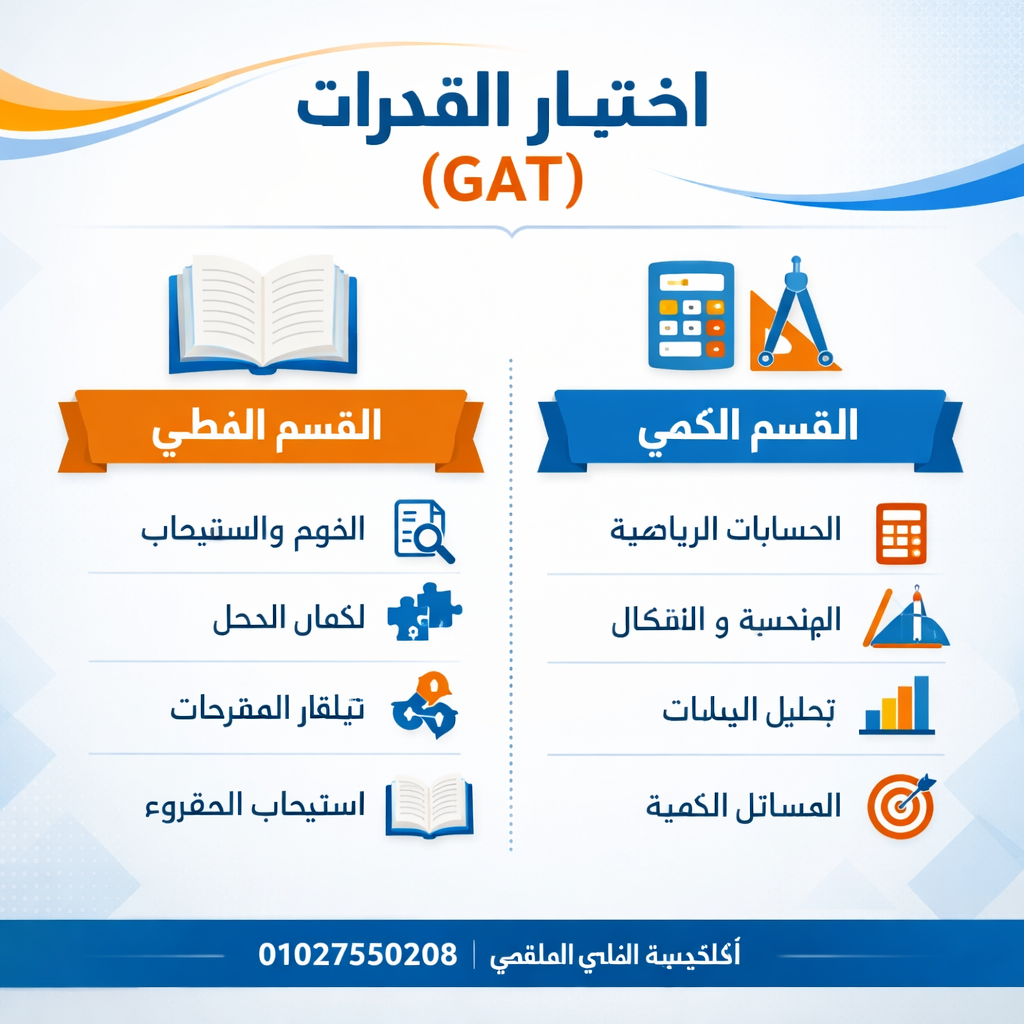
1.1. Components of an aptitude test: Verbal and quantitative
The test is divided into two main parts, each of which has its own nature and methods of measurement:
A. Verbal Section
This section focuses on measuring the student's understanding of the Arabic language and their ability to deal with vocabulary and texts. It usually includes the following sections:
•Reading comprehension: It requires reading relatively long texts and answering questions related to the main idea of the text, inferring implied meanings, and identifying relationships between sentences.
•Complete sentences: It depends on understanding the context of the sentence and choosing the right word or two to fill in the blanks, which requires a good vocabulary and the ability to make logical connections.
•Verbal symmetry: It requires identifying the relationship between a pair of words and selecting another pair with the same relationship (e.g.: doctor: hospital = teacher: school).
•Contextual error: It asks to identify the word that doesn't fit the overall meaning of the sentence, measuring the accuracy of language comprehension.
B. Quantitative Section
This part measures the ability to deal with basic mathematical concepts and solve problems in logical and fast ways. It includes topics such as:
•arithmetic and algebra: Basic operations, equations, percentages, and averages.
•Engineering: Measuring areas, volumes, angles, and working with geometric shapes.
•Analysis and statistics: Read and analyze data from graphs and tables.
•comparisons: Questions that require comparing two values to determine which is greater or if they are equal.
1.2. Strategies for excelling in abilities with the Science Club Academy
Succeeding in abilities requires more than just review, it requires Foundation وIntensive training on quick-fix strategies. In Jeddah Scientific Club AcademyWe focus on:
1.Develop thinking skills: Instead of memorizing rules, we train students how to deduce solutions and deal with new patterns.
2.Quick fix techniques: Teach students math and verbal shortcuts to save valuable time on the test.
3.Realistic simulation: Provide mock tests that simulate the actual test environment (computerized or paper-based) to break the barrier of fear and stress.
For a customized training plan, contact us now: 01027550208.
Section II: Scholastic Achievement Test - Measuring Scientific Achievement
While the aptitude test measures general mental aptitude, the Achievement test It measures the student's comprehension and understanding of the subjects learned during high school . It is an essential test for admission to scientific, health and engineering majors.
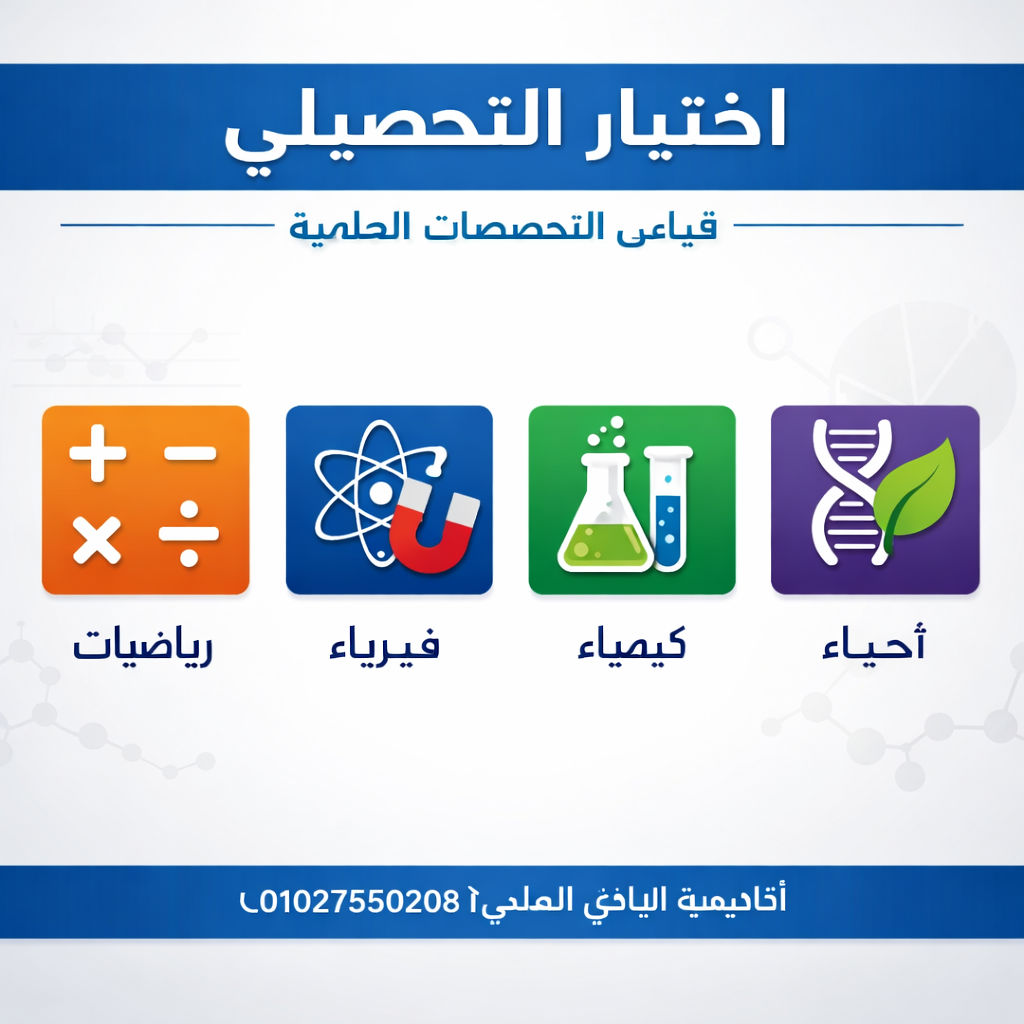
2.1. Subjects covered by the achievement test
The focus of the achievement test varies depending on the track the student follows (scientific or literary), but the greatest emphasis is on the scientific track:
|
Article
|
Approximate Question Percentage
|
Primary focus
|
|
Mathematics
|
25%
|
Algebra, Calculus, Analytic Geometry.
|
|
Physics
|
25%
|
Mechanics, electricity and magnetism, light and heat.
|
|
Chemistry
|
25%
|
Organic and inorganic chemistry, chemical calculations.
|
|
Neighborhoods
|
25%
|
Cytology, genetics, classification of organisms.
|
2.2. The Importance of Methodological Foundations in Achievement
A common mistake many students make is trying to review all of the curriculum in a short amount of time. Success in the achievement test requires:
1.Balanced distribution of the curriculum: Achievement test questions are distributed across the high school years in approximate proportions (20% from first grade, 30% from second grade, 50% from third grade). The review should focus on these ratios.
2.Deep understanding, not superficial memorization: Achievement questions measure the ability to apply concepts and solve problems, not just retrieve information.
3.Practice on previous models: Practicing past years' questions gives the student an understanding of the nature and wording of frequently asked questions.
In Science Club AcademyWe offer intensive courses and focused reviews that cover all these aspects, focusing on the most important points of the exam. Feel free to inquire about our courses in Jeddah and the UAE: 01027550208.
Third section: Scientific Club Academy - Your partner towards excellence in Jeddah and the UAE
In the midst of intense academic competition, it's not enough to simply study, it has to be targeted and based on proven and effective strategies. This is the pivotal role that Science Club AcademyWhere we do not only provide information, but we focus on building capabilities and developing the critical thinking and reasoning skills needed to achieve the highest scores in the aptitude and achievement tests. Choosing the academy is a strategic decision that guarantees you excellence in Grandma and Saudi Arabia, and its positive impact extends to students in the UAE who rely on our advanced curricula.
3.1. Advanced methodology: Foundation before training
The academy relies on a unique methodology that begins with “Deep Foundation” before moving on to the practice and modeling phase. We recognize that many students may have difficulties with basic math and Arabic concepts that they were unable to fully grasp in high school. Therefore, a large part of the course is dedicated to:
•Stabilize mathematical rules: A comprehensive review of the basic algebraic and geometric concepts that are the cornerstone of the quantitative portion of the IELTS.
•Boost your language skills: Intensive training on vocabulary, verbal relationships, and reading comprehension techniques to ensure full control of the verbal part.
•Comprehensive coverage of achievement courses: Achievement subjects (Physics, Chemistry, Biology, and Math) are broken down into small units, focusing on the parts that are repeated in formal exams, to ensure effective and targeted review.
3.2. Educational staff: Experience that translates into grades
The secret to a successful Science Club Academy lies in its team of specialized trainers and teachers. Our teaching staff is characterized by the following:
1.accumulated experience: All trainers have many years of experience in teaching the IQA and TAS curricula, and are fully aware of the latest models and changes in the tests.
2.Specialization: Each part of the test is taught by a specialist in its field (specialized quantitative trainer, specialized verbal trainer), ensuring the highest quality and in-depth explanation.
3.Individual follow-up: We believe that every student is unique, so individualized follow-up sessions are provided to identify each student's strengths and weaknesses and design a personalized study plan that ensures maximum benefit.
3.3. Learning environment and technology
In the age of digital transformation, the Academy utilizes the latest technology to deliver a flexible and efficient learning experience, whether you are in Grandma or any other city in the Kingdom or the UAE:
•Interactive platforms: Utilize advanced e-learning platforms that allow students to access recorded content, practice tests, and live discussions at any time.
•Simulated tests: Providing practice tests that simulate the computerized testing environment (CBT) with high accuracy, with detailed performance reports that help the student assess their level and identify areas that need more focus.
•Flexibility of attendance: Offering a variety of course options, including physical attendance at our centers (where available) and live virtual courses, to meet the needs of students in different regions.
To start your journey towards excellence, get in touch with our academic advisors now: 01027550208.
Section IV: Advanced strategies to ensure a 95+ score on the SAT and ACT
Achieving a score of 95% and above on the IQ and SAT is not a distant dream, but rather the result of applying thoughtful strategies and a meticulous methodology. These strategies are at the core of what we teach at Science Club Academy.
4.1. Quantum Part Strategies: Speed and Accuracy
The quantitative part requires speed in solving and accuracy in applying the rules. Here are the most important strategies:
|
Strategy
|
Description and application
|
|
Plugging In
|
Instead of solving complex algebraic equations, substitute the options available in the question. This method saves a lot of time on comparison and equation questions.
|
|
Estimation and rounding
|
In questions involving large numbers or decimals, use estimation and rounding to eliminate options that are far from the correct answer, minimizing the likelihood of error.
|
|
Engineering drawing and visualization
|
Don't just try to solve geometry problems mentally. Sketch the figure and identify what is needed. Drawing illustrates geometric relationships and helps to apply the laws correctly.
|
|
Using the Golden Rules
|
There is a set of “golden” mathematical laws that are repeated in abilities (such as the laws of exponents, roots, and averages). Mastering these laws guarantees a solution in a matter of seconds.
|
4.2. Strategies for the verbal part: Deep comprehension and logical connections
The verbal part relies on a deep understanding of language and the ability to make logical connections between ideas:
•Reading comprehension: Don't read the entire text in detail at first. Start by reading the questions first, then read the text for the answers. Focus on key phrases at the beginning and end of paragraphs.
•Verbal symmetry: Define the exact relationship (e.g., part-whole, opposition, cause-effect). Then apply the same relationship to the options.
•Complete sentences: Read the sentence with each option in an internal voice. The correct choice is the one that gives the sentence an integrated logical and contextual meaning.
4.3. Achievement strategies: Guided review.
The quiz is a knowledge test, but it requires intelligent review:
1.Concept maps: Use concept maps to connect scientific ideas and concepts to each other, rather than studying each chapter in isolation. This enhances understanding and minimizes forgetting.
2.Solve the assemblies: Don't just solve the combinations, understand why the answer is right and why the other answers are wrong. This is the essence of effective revision.
3.Study distribution: Allocate equal time to the four subjects (math, physics, chemistry, biology) and do not neglect any subject, as each subject carries the same weight in the final result.
Section V: Comprehensive comparison table: Aptitude vs. Achievement
To help with your planning, here's a table showing the key differences between the two tests, which is what we focus on in our training programs at Science Club Academy (For registration and inquiries: 01027550208).
|
Feature
|
General Aptitude Test (GAT)
|
Scholastic Achievement Test
|
|
Primary goal
|
Measuring reasoning and analytical ability and the ability to learn.
|
Measuring the extent of the student's understanding of the courses at the secondary level.
|
|
Content
|
General language and math skills (not based on a specific curriculum).
|
Specific science courses (math, physics, chemistry, biology).
|
|
Bookmark
|
Thinking and reasoning skills.
|
Secondary school curriculum (in varying proportions).
|
|
Number of parts
|
Two parts: Verbal and quantitative.
|
One part covers science subjects.
|
|
Number of attempts
|
5 attempts (usually).
|
4 attempts (usually).
|
|
Validity
|
5 years from the test date.
|
5 years from the test date.
|
|
Optimal preparation
|
Training on strategies and modeling.
|
Systematic review of courses and resolution of groupings.
|
Section VI: Common mistakes to avoid
Many students have the potential to achieve high scores, but make systematic preparation mistakes that lead to unsatisfactory results. In Science Club AcademyWe help you identify and avoid these mistakes to ensure your study plan goes smoothly.
6.1. Relying on memorization instead of understanding
•in capabilities: Ability questions cannot be memorized, as they are based on changing patterns. Trying to memorize solutions instead of understanding the mathematical or linguistic principle behind the question is a waste of time.
•In collecting: Although Tahsili is curriculum-based, the questions measure the ability to apply laws and concepts. Superficially memorizing formulas without understanding how to use them will not work.
6.2. Neglect of the foundation
Many students jump right into solving models and assemblies without making sure they've mastered the underlying concepts. This is like trying to build a loft without a solid foundation. The first 30% of study time should be devoted to Deep foundationwhich we include in our training programs.
6.3. Poor time management in the test
Time is the biggest enemy in both tests. The student must practice solving questions under time pressure. In an aptitude test, a single question should take no more than one minute on average to solve. Practicing timed practice tests is the perfect solution to this issue.
6.4. Excessive stress and anxiety
Stress can negatively affect mental performance. At the Academy, we not only provide academic training, but also psychological counseling and relaxation techniques to deal with test stress, ensuring that the student enters the test with maximum focus and confidence.
Section VII: Tips for test day: Mental and Physical Preparation
Preparing for test day is just as important as academic preparation.
1.Adequate sleep: Make sure you get 7-8 hours of deep sleep the night before the test. A tired mind can't function efficiently.
2.A healthy breakfast: Eat a light and nutritious breakfast. Avoid heavy foods or excessive sugars that can cause rapid lethargy.
3.Early access: Arriving at the test center at least 30 minutes before your appointment gives you time to relax and get used to the environment without feeling rushed.
4.Read the instructions: Don't rush to get started. Read all instructions thoroughly, and make sure you understand the answer mechanism and time allocation.

Conclusion: Your final step towards academic excellence
The journey to success in the Aptitude and Test Preparation Tests requires commitment, planning, and a trusted educational partner. In this comprehensive guide, we have provided you with a detailed roadmap, covering all aspects of the two tests and explaining our advanced methodology Science Club Academy To ensure its students excel in Grandma Saudi Arabia and the United Arab Emirates.
Don't leave your academic future to chance. Invest in yourself and start professional preparation now. Our team of experts is ready to provide the individualized support and follow-up you need to achieve a score of 95% and above.
To register for courses, inquire about methodologies, and get a free consultation, contact us directly:



No comment