

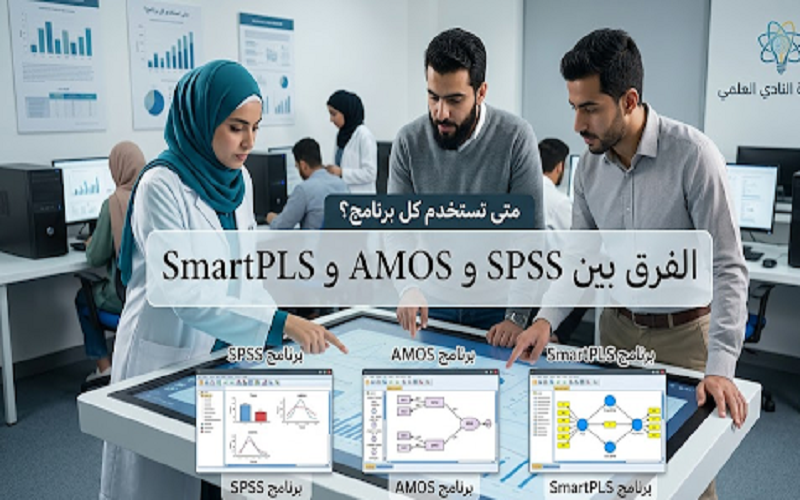
The difference between SPSS, AMOS, and SmartPLS: When to use each program?
Understanding the differences between SPSS, AMOS, and SmartPLS is the first and fundamental step for any researcher who wants to master the art of data analysis and choose the most appropriate methodology for their study. The issue is not limited to computer programs alone; it involves the quality of the relationships that you want to explore and the size of the available sample.
Whether you are looking for descriptive simplicity or delving into complex structural modeling, understanding the characteristics of each tool ensures you accurate results and strong conclusions, paving the way for presenting a solid scientific research characterized by professionalism and logic.
The difference between SPSS, AMOS, and SmartPLS
Statistical tools are numerous and their functions vary depending on the nature of the data and the research objectives. The differences between SPSS, AMOS, and SmartPLS are as follows:
Dealing with data
The differences between SPSS, AMOS, and SmartPLS are as follows:
SmartPLS relies on variance, where it tries to explain as much of the variance in the dependent variables as possible using R-squared, which means that it focuses on how much we can predict the results.
AMOS relies on the common covariance, so it does not care as much about prediction as it does about whether the actual data matrix matches the matrix assumed in your theory; it asks whether the model you have drawn resembles reality.
SPSS handles the raw values of the directly observed variables and does not view the model as a single entity but as separate linear relationships.
Type of measurement models
The difference between SPSS, AMOS, and SmartPLS in questionnaire design is as follows:
SmartPLS is the only powerful tool for dealing with Formative modeling models, where the questions are the ones that form the variable.
AMOS is designed primarily for regression models, where the variable that reflects the questions is job satisfaction, which leads to the appearance of positive emotions in the questions; if structural models are used in AMOS, complex technical problems will arise in the definition.
Dealing with underlying variables
SPSS does not recognize latent variables for analysis in a survey; you must first calculate their arithmetic mean and convert it to a single observed variable; this is where the measurement error is lost.
The differences between SPSS, AMOS, and SmartPLS deal with latent variables and take into account the measurement error for each question individually, which makes the results much more accurate than SPSS.
After building your model in SmartPLS, the first thing your supervisor will ask for is proof that each variable measures a distinct concept. We explain this in detail, with real examples, in our guide to discriminant validity in SmartPLS.
Measurement requirements
AMOS is very strict and if missing values or data that did not follow the normal distribution are present, error messages will be displayed and the model will not produce accurate results.
SmartPLS does not require a natural distribution of the data because it uses a resampling technique, which makes it the magic solution for the non-ideal data we often encounter in field studies.
Analysis of mediation and moderation
SPSS requires performing several separate tests or installing additional modules to do so.
AMOS allows for drawing paths and testing the mediation, but it is complex to test interaction or modified variables.
SmartPLS excels here with absolute ease, as you can add a Moderating coefficient variable with just one click and see its immediate impact on the graph.
Use SmartPLS if you are conducting exploratory research aimed at developing a new framework or predicting consumer behavior, and use AMOS if your research is confirmatory and aims to validate a previous global theory in a new environment. SPSS is your tool for preparing and cleaning data and performing simple traditional tests.
Read more:The importance of performing statistical analysis and interpreting the Saudi results
When do you use each program?
SPSS is used in descriptive statistics, testing differences between groups, and simple regression analysis of directly observed variables.
AMOS is used to test ready-made theoretical models and confirm their suitability for reality, provided that the sample size is large and the data follow a normal distribution.
SmartPLS is used when constructing complex predictive models or developing new theories, especially in the case of small samples or data that do not follow a normal distribution.
When is SPSS the best option?
The SPSS program is the optimal and systematic option in cases where direct statistical processing is required; its strength is particularly evident in the following:
Comprehensive descriptive statistics to summarize the data and extract the means and standard deviations with high accuracy.
When comparing groups using traditional statistical tests such as T-test and ANOVA.
In regression and association situations that rely on directly measured variables without the need for modeling the underlying variables.
When data follow a normal distribution and the homogeneity conditions are met, this ensures the strength of statistical inference.
In research with a clear and simple methodological structure that does not require complex causal models.
When you want to have familiar and easily interpretable tables and results for academic purposes, with arbitration committees.
In the event that the scientific department or the publishing house requires the use of reliable classical statistical analyses.
How can we help you analyze your data?
If you face challenges turning your research data into meaningful results, then with Science Club Academy Statistical analysis becomes more accurate and clear, as we act as a A Researcher's Guide to Mastering Quantitative Data Analysis We provide you with highly professional data analysis services under the supervision of a team of academic experts to ensure that the master's, doctoral, and applied research papers meet the highest global quality standards.
We rely on the latest software such as SPSS and AMOS to conduct accurate tests and interpret the results in a scientific and rigorous manner that supports the strength of your study. We adhere to complete confidentiality and methodological precision, while providing professional graphical reports that enhance the discussion of your results. This helps you reach strong and reliable research conclusions that are worthy of your academic career.

What is the most important thing that distinguishes our services at Science Club Academy?
It enjoys Science Club Academy With a wide range of features that include the following:
At Science Club Academy, we rely on the latest specialized software worldwide such as SPSS, AMOS, SmartPLS, and NVivo to ensure the utmost accuracy.
Our team also includes specialists in quantitative and qualitative analysis, who possess the skill to transform abstract numbers into concrete scientific facts.
We do not just rely on numbers; we work to provide professional charts and graphs with accurate and simplified scientific explanations for each result.
We can help you formulate the results and discussion section, linking them to the objectives of your study and to the theoretical heritage and previous studies.
We place the privacy of your data and the timing of your delivery at the forefront of our priorities, while fully adhering to the strictest methodological standards.
Try the free SmartPLS & AMOS model diagnostic lab
Enter your model results exactly as your software reports them and see which indicators are acceptable and which need attention: loadings, AVE, CR, HTMT, Fornell–Larcker and fit indices, with a short measurement-model paragraph in English and Arabic.
Frequently Asked Questions
What is the difference between SPSS, AMOS, and SmartPLS in terms of purpose?
SPSS is used for descriptive statistics and direct difference testing, but AMOS specializes in validating CFA theoretical models, where SmartPLS excels in constructing complex predictive and exploratory models.
Does one of these programs cater to the other?
SPSS is indispensable at the beginning for cleaning and describing the data, but when moving on to modeling structural equations, AMOS or SmartPLS must be chosen based on the sample size and data distribution.
Understanding the differences between SPSS, AMOS, and SmartPLS remains the first methodological step to ensure the accuracy of the results. The correct choice between these programs depends entirely on the nature of your research model and the size of the sample, ensuring that you can present a solid and rigorous scientific study.
Read more:
What is the price of statistical analysis in the UAE?
Designing and Analyzing Surveys: A Practical Guide for Researchers in Jeddah | Science Club Academy
The best courses in statistical analysis using R and SAS in Dubai Science Club Academy
Do you need help analyzing your research data?
The Science Club Academy team helps you prepare your data, analyze it, and interpret the results for master’s theses, doctoral dissertations, and research papers. Learn more about our Integrated statistical analysis service, and the consultation is free.




No comment