

Introduction: The importance of the research plan in the master's journey
The master's journey is a pivotal point in the academic and professional careers of any aspiring scholar, requiring careful planning and systematic work to ensure success and excellence. At the heart of this arduous and rewarding academic journey lies a crucial element, the cornerstone that defines its path and ensures its integrity: Research plan. It is not just a procedural document submitted to fulfill the admission requirements, but a strategic compass that guides the researcher through the complex maze of study and ensures that he reaches academic safety, achieving his research goals effectively and efficiently. In the context of Saudi Arabia and the UAE, where the pace of scientific and research development is accelerating at an unprecedented pace, and cities like Riyadh are emerging as a leading academic radiation center and a destination for scientific excellence, the need for strong and robust research plans that not only reflect academic quality, but also highlight innovation and originality in addressing scientific and societal issues increases .
Preparing a comprehensive research plan is not a mere formality, but a deep intellectual process that requires the researcher to think critically, analyze methodologically, and plan strategically. It is the first opportunity for the researcher to demonstrate their ability to define a clear research issue, formulate achievable goals, choose an appropriate methodology, and anticipate potential outcomes. The more detailed and comprehensive the plan, the smoother and more successful the research journey will be. This article is specifically for master's students and researchers in Riyadh and its surrounding areas, as well as in the UAE, who seek to prepare research plans that not only meet academic standards, but exceed them to achieve excellence.
This article aims to provide a comprehensive, practical, and detailed guide on how to write a strong master's research plan, focusing on the essential steps, core components, and best practices that will ensure your plan stands out and is accepted by prestigious academic committees. We will go through each stage of preparing the plan in meticulous detail, from the process of selecting an original research topic to documenting scientific references accurately and professionally, taking into account the strict academic requirements of prestigious universities in the region, such as King Saud University in Riyadh and leading UAE universities. We will also go in-depth on the importance of search engine optimization (SEO) to ensure it reaches the widest range of interested parties and researchers, and how the Scientific Club Academy can be your ideal partner and strong supporter in this ambitious academic journey, providing the necessary expertise and guidance to achieve your research goals.
1. Understanding the research plan: Definition and goals
What is the research plan?
A research plan, also known as a research proposal, is a detailed and robust academic document submitted by a master's student to comprehensively outline the parameters of their proposed study. It is not just a brief summary, but an integrated scientific roadmap that precisely defines the research issue that the research will address, the specific objectives it seeks to achieve, the precise scientific methodology it will follow to collect and analyze data, and the expected results the researcher hopes to reach. This plan is usually submitted to a specialized academic committee to assess the feasibility, originality, scientific relevance, and conformity with academic standards. This step is mandatory and crucial before the actual start of the dissertation, as it ensures that the research is based on sound scientific foundations and has added value .
A research plan is like a contract between the researcher and the university, outlining the obligations and expectations of both parties. It represents the researcher's vision for his/her study and demonstrates his/her ability to think systematically and plan properly. Through it, the supervisory committee can assess the researcher's understanding of his/her topic, his/her ability to deal with potential research challenges, and the extent to which his/her research contributes to enriching knowledge in his/her field. Therefore, the plan should be clear, comprehensive, and convincing, reflecting seriousness and professionalism in dealing with scientific research.
Key objectives of the research plan
The research plan serves several vital and integrated objectives, not only procedural, but also cognitive and methodological. These objectives ensure that the research process is organized, guided, and scientifically valuable:
•Guiding the researcher and clearly defining their path: The plan acts as a comprehensive guide for the researcher, helping him to organize his scattered ideas, define his research path clearly and accurately, and avoid the distractions that may occur during the various stages of research. It ensures that the researcher has a deep and comprehensive understanding of what they will do, how they will do it, and the steps they must follow, providing them with a stable frame of reference throughout the study . This guidance minimizes the likelihood of deviating from the original research path and increases work efficiency.
•Convince the academic committee and supervisors of the feasibility of the research: The plan is your first golden opportunity to convince supervisors and academic committee members that your proposed research is worthy of consideration and funding (if any), and that it possesses scientific originality, academic and applied relevance, and realistic feasibility. The plan should demonstrate your superior ability to think critically, analyze systematically, and formulate research ideas in a convincing and logical manner . Academic acceptance of the plan is the green light to start the actual work on the dissertation.
•Determine the timeline and resources required: The plan provides an estimated timeframe for accomplishing each phase of the research, as well as an estimate of the human and material resources required. This helps in managing time and resources effectively and efficiently, and minimizes the likelihood of delays or budget overruns. It also clearly defines the scope of the study and sets limits to prevent unwarranted expansion that may make it difficult to complete the research on time .
•Identifying the research gap and scientific contribution: Through the process of reviewing and critically analyzing previous studies, the plan helps the researcher identify the knowledge gap or deficiency in the current research literature that his/her research will fill. This precise identification of the research gap highlights the original scientific contribution that the research will make, and emphasizes its importance and added value to the academic field .
•Developing researcher skills: The process of preparing the research plan itself is an intensive training for the researcher in critical thinking, analysis, planning, and academic writing skills. It prepares the researcher for the later stages of the dissertation and gives them the experience needed to deal with research challenges.
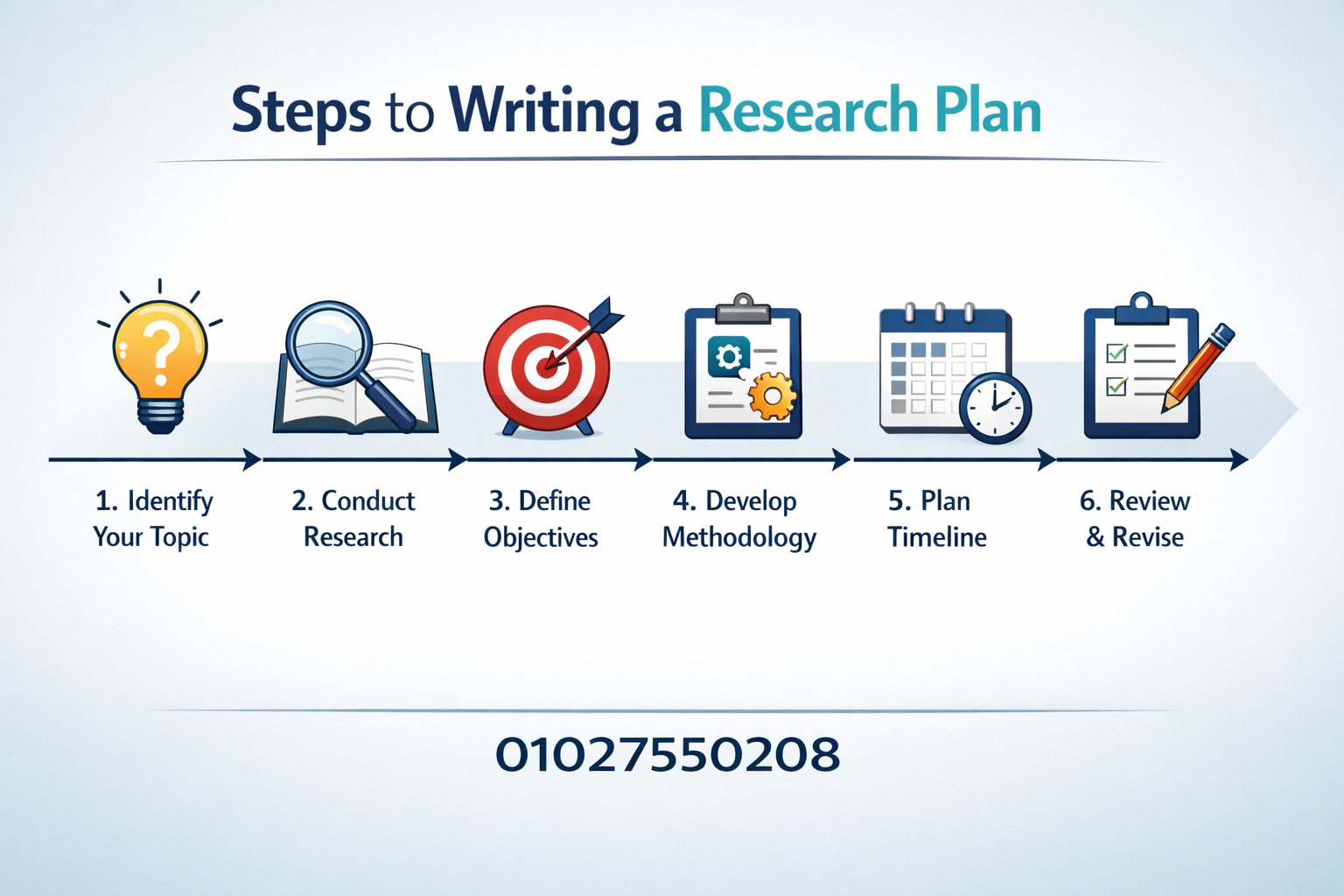
2. Practical steps to write a strong master's research plan
Writing a strong and comprehensive research plan requires following systematic and carefully organized steps. Each step builds on the previous one and paves the way for the next, ensuring the integrity and consistency of the plan. Here, we will review these steps in great detail, providing practical tips and detailed instructions to ensure the quality of each component of the plan and maximize its professionalism.
2.1. Choosing a research topic: The solid foundation for the academic journey
Choosing a research topic is the first, most important and sensitive step in the entire master's journey. It is the foundation on which your study will be built, and therefore it must be a well-considered and thoughtful choice. The topic should be original, highly relevant to your field of specialization, and practically researchable. Here are some basic criteria and golden tips that will help you make this crucial decision:
•Originality, novelty and scientific contribution: Try hard to choose a topic that has not been adequately addressed in the research literature, or you can provide a new and innovative perspective on an old and well-known topic. Originality greatly increases the value of your research and highlights your contribution to knowledge. Avoid direct replication of previous studies; instead, look for unexplored corners or obvious research gaps .
•Importance, Relevance, and Application: The topic should have a clear scientific or applied relevance and should effectively contribute to solving an existing issue in society or add to the accumulated knowledge in your specialized field. Think deeply about how your potential research will impact society, professional practice, or the academic discipline itself . Will your research provide solutions to real-world issues? Will it open up new avenues for future research?
•Personal interest and passion for research: Choose a topic that you are truly passionate about and deeply interested in. This passion will give you the motivation to keep going when you face the inevitable challenges and difficulties that may arise along the way . Researching a topic that doesn't interest you can lead to boredom and loss of motivation, which negatively affects the quality of your work.
•Availability of scientific sources and references: Before settling on a topic, make sure there are sufficient and reliable sources (e.g. books, peer-reviewed scientific articles, previous studies, academic databases) to support your research. Difficult access to sources can significantly hinder your progress and affect the quality of the results. Conduct extensive preliminary research to make sure there is an abundance of scientific material .
•Feasibility and realism in delivery: Can you accomplish the research within the time frame of your master's program? Are the available resources (e.g., funding, tools, access to data) sufficient to conduct the study? Avoid topics that are too broad and require years to accomplish, or those that require huge resources that are not available. Be realistic about your abilities and resources .
Tips for narrowing the topic: Researchers often start with very broad ideas. To narrow the topic, start with a general idea and then gradually narrow it down using specific questions (who? what? where? when? why?). For example, instead of talking about “the impact of AI on education,” which is a very broad topic, you can narrow it down to “the impact of using interactive AI applications on the academic achievement of secondary school students in Riyadh public schools during the academic year 2025-2026.” This narrowing makes the topic more searchable and manageable.
2.2. Crafting the research title: The first gateway to an academic impression
The title of the paper is the first thing the reader and the academic committee look at, and it serves as a mirror that reflects the essence of your study and its content. The title should be catchy, accurate, and unambiguously express the content of the paper. Crafting an effective title requires skill and precision, and here are the characteristics of a good title to consider:
•Clarity, Accuracy and Specificity: The title should be crystal clear, leave no room for ambiguity or interpretation, and accurately identify the key research variables, target population, and setting (if any). It should be specific enough to give a clear idea of what the research will cover . For example, instead of “a study on education”, it could be “the impact of project-based learning on the problem-solving skills of engineering students at King Fahd University of Petroleum and Minerals”.
•Comprehensive, concise and balanced: The title should be comprehensive enough to reflect the content of the entire paper, yet concise enough to avoid unnecessary length. In most universities, the length of the title should not exceed 15 words, but it is important to strike a balance between comprehensiveness and brevity . Avoid superfluous words or filler that doesn't add meaning.
•Attractive and interesting: The title should pique the reader's interest and encourage them to read more of the research plan. This can be achieved by using strong and expressive words, or a style that implicitly asks a question or highlights the importance of the topic. A catchy title increases the chances of reading and being interested in the paper.
•Reflect the research question and its main objectives: The title should give a clear and direct idea of the research issue addressed by the research and the main objectives it seeks to achieve. There should be a logical connection between the title, the research issue, and the research objectives. This connection shows the extent of the researcher's understanding of his topic.
Practical examples:
•A good, specific title: “The impact of using active learning strategies based on digital simulation on the development of creative thinking and problem solving skills of upper elementary students in Riyadh private schools: An Applied Study.” This title clearly defines the variables, community, place, and curriculum.
•Poorly written and undefined title: “A Study on Education and Students in Riyadh.” This title is too general, doesn't identify an issue, doesn't clarify goals, and lacks precision.
2.3. Introduction to the research plan: First impressions and introduction to the study
The research plan introduction is your golden opportunity to provide a comprehensive overview of your proposed study, capturing the attention of the reader and the academic committee at the very first glance. The introduction should be concise, comprehensive, and persuasive, setting the stage for what comes in the subsequent sections. The introduction usually includes the following key components, which should be carefully crafted:
•General background and importance of the topic: Begin by providing an overview of your topic, emphasizing its importance in an academic, societal, or economic context. You should show the reader that this topic is not just a personal interest, but is broadly relevant and has important implications. You can start from the general to the specific, that is, from the importance of the field in general to the importance of the specific topic . For example, if the topic is about AI in education, you can start by talking about the digital revolution and its impact on education in general, and then move on to the role of AI.
•Relevance and the knowledge gap: Explain clearly and concisely why this topic is important and worthy of study and research. What is the knowledge gap or gap in the current research literature that your research seeks to fill? You should emphasize that your research will add to knowledge, not just repeat what is already out there. You can refer to previous studies and explain where they stop and where your research will begin .
•Clear and specific research question: Conclude the introduction by clearly presenting the research question that will be the primary focus of your study. The issue should be specific, researchable, and formulated in the form of a question or statement that clarifies the challenge or issue that the research will address . For example, instead of saying “there is an issue in education,” you could say “despite significant advances in educational technologies, there is still a lack of understanding of how interactive AI applications affect the development of critical thinking skills of undergraduate students in hybrid learning environments.”
2.4. Defining the research question and research questions: The core of the study and the basic premise
Defining the research question is the most important and sensitive step in any scientific study; it is the essence of the study and its basic premise. Without a clear and well-defined issue, the research lacks direction and purpose, and becomes a mere collection of information without purpose. Once the issue is clearly defined, the research questions or hypotheses that will guide data collection and analysis are formulated.
•Define the research question clearly and precisely: The research question must be specific, measurable, and relevant to the academic field and society. The issue can stem from several sources, such as the researcher's personal observations, a critical reading of previous studies that reveal gaps, or pressing societal issues that require research solutions . Most importantly, the issue should be a specific question that requires an answer through scientific research, not just a general topic. For example, instead of “the issue of unemployment,” it could be “the impact of specialized vocational training programs on reducing unemployment rates among Saudi youth in the technology sector in Riyadh.”.
•Formulating research questions or hypotheses: After defining the issue, it is time to formulate the questions or hypotheses that will guide the research:
•Search questions: These are specific and direct questions that the research seeks to answer. Questions should be clear, researchable, and connected to the research question and objectives. For example: “What is the impact of using interactive AI applications on the development of critical thinking skills of undergraduate students in hybrid learning environments?” .
•Hypotheses: They are speculative statements or tentative assumptions about the relationship between two or more variables, the validity of which is tested through data collection and analysis. Hypotheses are typically used in quantitative research. For example: “There is a statistically significant effect of using interactive AI applications on the development of undergraduate students” critical thinking skills in hybrid learning environments." .
2.5. Define the research objectives: Objectives of the study
Research objectives are the specific goals that the researcher seeks to achieve through their study. Objectives should be clear, measurable, achievable, relevant, and time-bound (SMART). Objectives are usually derived from the research question and clarify what the researcher hopes to discover or prove.
•Main goals: These are general objectives that reflect the overarching purpose of the research. For example: “To determine the impact of using interactive AI applications on the development of critical thinking skills of undergraduate students in hybrid learning environments.”
•Sub-objectives: These are more specific and detailed goals that contribute to the main goal. For example:
•“Measuring the level of critical thinking skills of undergraduate students before using interactive AI applications.”
•“Measuring the level of critical thinking skills of undergraduate students after using interactive artificial intelligence applications.”
•“Comparing the differences in critical thinking skills between the experimental and control groups.” .
2.6. The importance of research: Why is your study worthwhile and worth supporting?
In this pivotal part of the research plan, the researcher must demonstrate the real added value of their study, both in terms of academic theory and practical application. Answering the question “Why is your study worthwhile?” or “Why should others care about your research?” is the core of this section. This section should be convincing and strongly justified, highlighting the potential impact of the research on knowledge and society.
•Theoretical relevance and contribution to knowledge: How will your research contribute to existing knowledge in your specialized field? Will it introduce a completely new theoretical framework, expand an existing understanding of a particular theory, or test an existing theory in a new and unexplored context? You should clearly explain how your research will fill a clear knowledge gap in the research literature, provide new and innovative explanations for complex phenomena, or open up new and exciting avenues for future research . For example, your research may contribute to the development of a new theoretical model that explains digital consumer behavior in the Arabian Gulf region, or provide new insights into the impact of cultural changes on the adoption of new technologies in higher education.
•Applied relevance and tangible practical benefits: What practical and tangible benefits can result from your research? How can the results of your study be used to solve real-life issues faced by individuals, organizations, or society as a whole? Can they contribute to improving practices, developing more effective public policies, or steering business strategies toward more successful paths? For example, your research findings may provide practical recommendations to educational institutions on how to effectively integrate AI to enhance the learning experience, to governments on formulating policies to support innovation and entrepreneurship in emerging sectors, or to companies to optimize their marketing strategies in local markets.
•Beneficiaries of research results and impact: Clearly identify the different groups that will benefit directly or indirectly from the results of your research. This can include academics and other researchers in the same field who will build on your findings, graduate students who will benefit from the theoretical and methodological framework, educators and decision-makers in the public and private sectors, non-profit organizations pursuing social goals, and even society at large who will benefit from the proposed solutions. Identifying beneficiaries highlights the broader impact of your study and emphasizes its relevance and long-term usefulness.
2.7. Search limits: Scope and focus
Defining research boundaries is an essential process to ensure that the study is manageable and achievable within the available resources and time. Boundaries help to focus the research and avoid unwarranted expansion that may lead to difficulties in accomplishment. Research boundaries are typically divided into three main types:
•Substantive (conceptual) limits: It relates to the scope of the topic and the concepts and variables to be studied. For example, if the research is on the impact of AI on education, the objective limits might be to focus on a particular type of AI application (e.g. machine learning) and on specific skills (e.g. critical thinking) and not others .
•Spatial boundaries: Specifies the geographic area or institutions where the research will be conducted. For example, the search may be limited to “universities in Riyadh” or “public secondary schools in Dubai” .
•Temporal boundaries: Specifies the time period that the study will cover, whether it is the period of data collection or the period covered by the phenomenon being studied. For example, “during the academic year 2024-2025” or “data collected between 2020 and 2023” .
2.8. Search terminology: Standardize understanding and avoid confusion
The researcher must identify and procedurally define the key terms and concepts that will be used in the research. This ensures uniformity of understanding between the researcher and the reader, and avoids any confusion or misunderstanding that may arise from the use of terms with multiple meanings. Definitions should be clear, accurate, and based on scientific literature .
•Linguistic definition: The general meaning of the term as mentioned in linguistic dictionaries.
•Idiomatic definition: The special meaning of the term in a scientific or specialized context.
•Procedural definition: How the term is measured or observed in the context of the current research. For example, “Critical thinking procedurally is the score a student gets on a critical thinking test prepared by the researcher.”
3. Theoretical framework and previous studies: Based on the above
3.1. Theoretical framework: The conceptual basis of the research
A theoretical framework is a set of concepts, theories, and principles that form the intellectual foundation of the research. It provides the lens through which the researcher views and analyzes the research question. The theoretical framework should be consistent with the research question and objectives, and show how the different variables relate to each other .
•Importance of the theoretical framework: It helps in understanding the studied phenomenon, guiding the process of collecting and analyzing data, and interpreting the results. It also connects current research to the accumulated knowledge in the field.
•Building the theoretical framework: Requires a thorough review of the literature, identifying relevant theories, and explaining how these theories can be applied to the research question. Conceptual models or diagrams can be used to illustrate the relationships between variables.
3.2. Previous studies: A critical and comprehensive review
Reviewing previous studies is a crucial process in preparing a research plan, as it helps the researcher understand what has been done in their field, identify research gaps, and avoid duplication of efforts. The review should be critical, not merely summarizing, and focus on the studies that are most relevant to the research topic .
•Objectives of the literature review: Identifying research gaps, building the theoretical framework, developing the methodology, comparing results, and identifying the unique contribution of the current research.
•Organizing previous studies: They can be organized chronologically, by topic, or by methodology. Each study should be summarized with a focus on its issue, objectives, objectives, methodology, and main findings. Next, the researcher must critically analyze these studies, identify similarities and differences, and finally, highlight the gap that their research will fill .
4. Research methodology: Roadmap for collecting and analyzing data.
Research methodology is the backbone of any scientific study. It determines how data will be collected and analyzed to answer the research questions and achieve the research objectives. The methodology must be clear, accurate, scientifically justified, and appropriate to the nature of the research question. This methodology provides a detailed roadmap for the researcher, ensuring that he or she is headed in the right direction and avoids randomness.

4.1. Type of research approach: Choosing the right instrument
The researcher must determine the type of research method to be used in their study and justify their choice based on the nature of the research question and its objectives. There are several main research methods, each with its own characteristics and uses:
•Descriptive approach: It aims to describe phenomena as they actually are, and to gather accurate and comprehensive information about them. It is used to answer questions such as “what?” and “how?” For example, describing students' attitudes towards distance learning .
•Analytical approach: Aims to analyze phenomena and relationships between variables, explaining causes and effects. It is often used to analyze existing data or to understand complex relationships .
•Experimental approach: It aims to test hypotheses by controlling variables and applying a specific treatment to an experimental group and comparing it to a control group. It is used to determine cause and effect relationships .
•Historical approach: It aims to study past events to understand the present and predict the future, by collecting and analyzing historical documents and sources.
•Mixed approach: Combines quantitative and qualitative approaches to capitalize on the strengths of each and provide a deeper and more comprehensive understanding of the phenomenon studied .
4.2. Research population and sample: Who will we study?
•Search community: It is all individuals or elements that possess the characteristics that the researcher is interested in in his study. For example, all master's students at King Saud University .
•Research sample: A representative part of the research population chosen to conduct the study and generalize the results to the original population. The sample must be representative of the population to ensure the validity of generalizations .
•Sample selection methods: There are different methods of sample selection, such as simple random sampling, stratified sampling, cluster sampling, systematic sampling, and purposive sampling, among others. The method of selection should be justified based on the nature of the research and the available resources .
4.3. Data collection tools: How will we collect data?
The researcher must identify the tools they will use to collect data, with a detailed description of each tool and how to apply it. Common tools include:
•Questionnaires: Used to collect quantitative data from a large number of individuals. The questionnaire must be carefully designed to ensure reliability and validity .
•Interviews: Used to collect in-depth qualitative data from a small number of individuals. Can be structured, semi-structured, or unstructured .
•Note: Used to collect data about behaviors or phenomena in their natural environment. It can be direct or indirect, participant or non-participant observation .
•Tests: Used to measure abilities, skills, or knowledge. Tests must be valid, reliable, and appropriate to the level of the sample .
•Content analysis: Used to analyze text, images, or other media materials to identify patterns or themes .
4.4. Search procedure: Implementation steps
The researcher must describe the procedural steps they will follow to carry out the research, from obtaining the necessary approvals, to collecting the data, to analyzing it. The procedures should be detailed and clear, so that another researcher can replicate the study .
•Obtaining ethical approvals: Make sure to get approval from the university's ethics committee before starting data collection, especially if the research involves human participants.
•Pilot Study: Conduct a small pilot study to ensure the effectiveness of the tools and clarity of instructions before actually applying them to a large sample.
•Data collection: Describe how the data will be collected, who will collect it, and the timeline.
•Data analysis: Describe the statistical methods (for quantitative research) or qualitative methods that will be used to analyze the data. For example, using SPSS to analyze quantitative data, or content analysis for qualitative data .
5. Scheduling and budgeting: Managing resources efficiently
Time planning and budget estimates are an integral part of the research plan, as they ensure that the study is realistic and achievable within the available resources. Developing a detailed timeline and an accurate budget reflects the researcher's professionalism and ability to manage the research project effectively.
5.1. Scheduling (time plan):
The researcher must provide a detailed timeline showing the main phases of the research and the expected duration of each phase. A Gantt Chart or other form of scheduling can be used. Key phases typically include
•Choosing a topic and drafting the initial plan:: (1 month)
•Literature review and previous studies: (2 months)
•Developing research tools:: (1 month)
•Obtaining ethical approvals: (two weeks)
•Data collection: (2 months)
•Data analysis:: (one and a half months)
•Writing the first draft of the thesis: (2 months)
•Review and audit:: (1 month)
•Presentation and discussion:: (1 month)
These estimates should be realistic and achievable, taking into account any potential obstacles or unforeseen delays.
5.2. Projected (estimated) budget:
Although many master's theses do not require significant funding, it is important to estimate the potential costs of the research. The budget can include the following items:
•Data collection costs: Such as travel costs, printing, purchasing surveys, or obtaining data from certain entities.
•Data analysis costs: Such as purchasing statistical software or hiring specialists in statistical analysis.
•Reference and sourcing costs: Such as buying books, or subscriptions to scientific databases.
•Printing and binding costs: To copy the final message.
•Miscellaneous costs: Stationery, telecommunications, etc.
The budget should be detailed and realistic, with justification for each item of expenditure.
6. References and appendices: Documenting Scientific Effort
6.1. List of references: Scientific Honesty and Accurate Documentation
The reference list is an essential part of any research work, as it reflects the researcher's scientific integrity and documents the sources on which he or she based his or her study. The list should be comprehensive, accurate, and organized according to one of the recognized academic documentation styles (e.g. APA, MLA, Chicago, or IEEE). APA style is preferred in most humanities and social sciences disciplines .
Examples of APA style referencing (7th edition):
•Book: Author, A.A. (Year). Book title. Publisher.
•Example: Al-Shami, M. A.. (2018). Scientific Research Methods: Foundations and Applications. Dar Al-Masirah for Publishing and Distribution.
•A chapter in an edited book: Author, A.A. (year). Chapter title. In B. B. Editor (editor). Book title (Pages). Publisher.
•Example: Al-Zahrani, S. Kh. (2020). Critical thinking in higher education. In V. M. Al-Otaibi (Ed.). Contemporary Issues in Higher Education (pp. 112-130). King Saud University.
•Article in a scientific journal: Author, A.A. (year). Title of the article. Journal Name, Volume(Issue), Pages. DOI (if available).
•Example: Al-Harbi, N. R. (2019). The effectiveness of an AI-based training program in developing secondary school students' problem-solving skills. Journal of Educational and Psychological Sciences, 15(2), 45-60.
•Unpublished master's or doctoral thesis: Author, A.A. (Year). Message title [Unpublished master's thesis or unpublished doctoral dissertation]. Name of the university.
•Example: Al-Qahtani, A. S. (2021). The impact of blended learning on the academic achievement of master's students at Imam Muhammad bin Saud Islamic University [Unpublished Master's Thesis]. Imam Muhammad bin Saud Islamic University.
•Website: Author, A.A. (year, month, day). Page title. Site name. Site link.
•Example: Scientific Club Academy. (no date). Science Club Academy Services. https://www.scientificclub.com/services
6.2. Appendices: Supporting materials
Appendices are used to include additional material that supports the research but is not an essential part of the main text. Appendices can include:
•Study tools: Such as questionnaires, interview forms, or tests used.
•Letters of consent: Such as official approvals or participant approvals.
•Raw data: If they are necessary for a full understanding of the research.
•Additional photos or diagrams: Cannot be included in the main text.
Each appendix should be referenced in the main body of the thesis, and each appendix should have a clear title and serial number.
7. Search Engine Optimization (SEO): Reach the widest audience
In today's digital age, academic excellence alone is no longer enough to ensure that your research work reaches the widest possible audience. Search engine optimization (SEO) has become a necessity, especially if you're looking to increase awareness of your research, attract the interest of other researchers, or even get funding opportunities. Here's how to apply SEO principles to your research plan:
7.1. Keywords:
•Identify relevant keywords: Think about words and phrases that researchers or those interested in your field of study might use to search for information. Use keyword research tools (such as Google Keyword Planner) to identify the most common and relevant words. For example, in this article, the keywords are: “master's research plan”, “how to write a research plan”, “master's thesis Riyadh”, “scientific club academy”, “SEO research plan”.
•Natural Keyword Integration: Incorporate these keywords into the search plan title, introduction, subheadings, and throughout the text naturally and seamlessly, without padding. The content should be valuable first, and SEO optimization comes second.
7.2. Content Structure:
•Use subheadings (H1, H2, H3): Use subheadings logically to organize content and make it easy to read and understand. Search engines prefer well-organized content. Make sure the article title is H1, headlines are H2, subheads are H3 and so on.
•Short paragraphs and clear sentences: Write short paragraphs and sentences that are clear and direct. This improves readability and makes the content more appealing to readers and search engines alike.
•Raster and digital menus: Use bulleted and numbered lists to make complex information easier to read and summarize key points, as in this article.
7.3. Internal and External Links:
•Internal links: If you have previous relevant articles or studies on your site or blog, link to them within the search plan. This helps distribute Page Authority and improves the user experience.
•External links: Link to credible and authoritative sources (e.g. universities, scientific journals, government websites) to support your arguments and increase the credibility of your research. This signals to search engines that your content is authoritative and of high quality.
7.4. Images and Multimedia:
•Photo optimization: Use high-quality images that are relevant to the content. Name your image files with descriptive names that include keywords (e.g. research-plan-steps-01027550208.png). Use descriptive Alt Text for images, as this helps search engines understand the content of the image and improves accessibility .
•Contact Number Integration: Make sure the professional images created clearly and professionally label the contact number (01027550208), as required.
8. The role of the Science Club Academy in supporting your research journey
At Science Club Academy, we recognize the challenges master's students face in preparing strong research plans. Therefore, we offer a comprehensive range of consulting and training services tailored to support you at every step of your research journey, from choosing a topic to drafting the final dissertation.

8.1. Our services:
•Topic Selection Consulting: We help you identify an original, relevant, and achievable research topic that matches your interests and specialization.
•Help with drafting a research plan: We provide support in drafting all components of the research plan, from introduction and objectives to methodology and references, while ensuring compliance with strict academic standards.
•Data Analysis and Statistics: We provide quantitative and qualitative data analysis services using state-of-the-art statistical software and provide clear interpretations of the results.
•Proofreading: We ensure that your dissertation is free of grammatical and spelling errors and conforms to the required academic style.
•SEO optimization support for academic content: We help you apply SEO best practices to your articles and papers to maximize their visibility and impact.
8.2. Why Choose Science Club Academy?
•Extensive experience: A team of academics and experts with long experience in supervising master's and doctoral theses.
•Unrivaled quality: Commitment to the highest standards of quality and accuracy in all services provided.
•Personalized support: We provide individualized and customized support to each researcher, with a deep understanding of their needs and challenges.
•Punctuality: We ensure that the work is delivered in the agreed upon times, while maintaining quality.
Don't let research challenges get in the way of your academic career. Contact us today at 01027550208 And let us help you build a solid research plan and an outstanding master's thesis.
Conclusion: Toward an outstanding master's thesis
Writing a strong research plan for your master's thesis is not just a procedural step, it is an investment in your academic and professional future. It lays the foundation for a successful research career and ensures that your academic journey is organized, guided, and of real scientific value. By following the methodological steps covered in this article, from carefully selecting a topic, to accurately formulating the research question and objectives, to determining the appropriate methodology and documenting references with scientific honesty, you can build a research plan that not only meets academic standards, but exceeds them to achieve excellence.
Always remember that a research plan is a mirror that reflects your research capabilities and commitment to quality. Invest your time and effort in preparing it carefully, and don't hesitate to seek help from experts and specialists. At the Science Club Academy, we are here to support and guide you at every stage of this important academic journey. Contact us on 01027550208 Start your journey towards academic excellence and achieve your research goals with confidence.
References:
For networking and academic support:
Science Club Academy: 01027550208





No comment