

Have you ever thought about how learning foreign languages can change your life? In our connected world, this skill has become a key to success, mastering a second language opens unexpected doors, from international job opportunities to communicating with diverse cultures, we at Science Club Academy believe that the journey needs more than just memorization, the right methodology and practical training are the basis for progress, so we offer programs specifically designed to achieve tangible results, in this article you will learn about effective strategies, you will discover how you can develop your skills on a daily and enjoyable basis.
Key points of foreign language learning
In the following points, we will learn about the most important points that help to learn foreign languages:
- Expand professional and personal horizons by mastering new languages.
- The importance of following an integrated practical methodology, not just memorization.
- The role of the Science Club Academy in providing effective educational programs.
- The need for daily practice and continuous training to achieve success.
- The multiple benefits of language proficiency in work and social life.
Foreign languages require the most memorization
Have you ever wondered why so many people still can't speak fluently despite memorizing thousands of words? The secret is that true mastery of any language does not depend on memorization alone. Integrated approach Relying on memorization is like building a house without a foundation; you may be able to remember the rules and vocabulary, but you will face great difficulties when using them in practice, and one of the most prominent challenges faced by language learners:
-
Forgetting information quickly due to lack of practical application.
-
Difficulty understanding different accents in real situations.
-
Inability to form natural sentences during conversation.
The difference between theoretical learning and practical application is similar to the difference between reading a book about swimming and experiencing the experience yourself; the first gives you knowledge, while the second gives you skill, the integrated methodology is what transforms theoretical knowledge into a tangible usable skill, and through our academic experience, we emphasize that Daily practice and real interaction with the language At our academy, we believe that combining structured knowledge with guided practical application is the best way to achieve success in your language proficiency journey.
The importance of having a clear methodology in language learning
Have you ever tried to build a house without a blueprint? This is exactly what happens when you try to master a new language without a clear plan, the difference between success and failure often lies in having a thoughtful methodology:
Why do traditional methods fail?
Old methods focus on memorization and repetition without real understanding, this leads to rapid forgetting and constant frustration, the issue is not the learner, but the ineffective method, one of the main reasons for failure in traditional methods:
- Relying only on memorization without practical application.
- There is no logical progression in the introduction of skills.
- Lack of regular measurement of progress.
- Not taking into account individual differences between learners.
How does the methodology deliver tangible results?
A clear methodology is like a roadmap to mastery, giving you a structured framework and clear steps that can be measured, this is exactly what we focus on at the Scientific Club Academy, through our programs designed according to each learner's goal, we guarantee you:
- Set clear and measurable goals.
- Divide the journey into progressive stages.
- Continuous monitoring of progress and performance improvement.
- Avoid distractions and focus on priorities.
When you accurately define your goal and regularly measure your progress, you become more motivated and focused, this strategy helps you establish a proper foundation and makes your journey more enjoyable and effective, choosing the right methodology depends on your personal goal and abilities, we offer free consultations to help you choose the best path to achieving your goals, we offer free consultations to help you choose the best path to achieve your goals.
The First Foundation for Successful Language Proficiency
Did you know that 80% of learners stop continuing because of a lack of clarity of purpose? The right start starts with setting a clear direction for your journey, without a specific goal, the journey is like traveling without a map, you may get somewhere, but you will never know if it's the right place:
How do you set your goal for mastering the language?
Start by asking yourself: Why do I want to master this skill? The answer sets your entire course, some questions to help you:
- Do I need it for a promotion at work?
- Am I planning to study abroad?
- Do I want to connect with new friends?
Clear goals save you time and effort, and give you the energy to keep going when you feel tired.
The difference between academic, professional, and communication goals
Each of these types of goals needs a different approach, the right understanding ensures you don't waste time:
- Academic Goals It focuses on grammar and specialized vocabulary, in order to study at international universities.
- Career Goals You need business language and technical jargon to communicate with colleagues and clients.
- Communication objectives She is interested in everyday conversation and culture, for tourism or making friends.
Use SMART criteria to set your goals, make them specific, measurable, achievable, relevant, and time-bound, we advise you to review your goals every three months, life changes, and your goals may need to be adjusted, flexibility in planning does not mean abandoning the dream, but rather reaching it in the best possible way.
The secret to mastering foreign languages
Do you know the difference between someone who knows the rules and someone who speaks fluently? The answer lies in the amount of Practical training Every day, theoretical knowledge alone does not make a good speaker, practical exercises turn information into tangible skills, and every minute you practice language brings you one step closer to Mastery The real one.
Why is practical application considered more important than theoretical learning?
The difference is like someone who reads about swimming and someone who goes into the water. Skill. Benefits Application Practical:
- Turning abstract rules into automatic habits.
- Gradually build confidence in real situations.
- Detect errors and correct them immediately.
- Develop a quick wit in responding.
The brain learns faster when it connects information to experiences, which is why Daily practice Essentially indispensable.
How can you make daily exercise part of your routine?
Continuity is the key to progress, here are practical ways to incorporate language into your life:
| Time | Activity | Interest |
|---|---|---|
| Morning | Listen to news in the target language | Improving pronunciation and comprehension |
| noon | A brief conversation with a native speaker | Building confidence in speaking |
| Evening | Write a summary of your day in the new language. | Improving writing skills |
| While traveling | Listen to an educational podcast | Making the most of lost time |
- Make Practical training Fun and varied, the more fun the better.
- Start with 15 minutes a day and gradually increase the amount of time. Continuity Not the quantity.
- Use interactive apps and participate in speaking groups, the environment plays a big role in Success.
- Measuring your progress weekly motivates you to keep going, record yourself speaking and compare the recordings.
- Repetition and revision stabilize the information in the long-term memory, don't learn new until you master the old.
The Scientific Club's Academic Methodology in Language Teaching
Does success in mastering any skill start with choosing the right methodology? We believe that every learner has unique characteristics and abilities, which calls for the preparation of Customized educational plan Our educational philosophy is based on the principle of Personalized learning designwhich is based on analyzing the learner's level, identifying strengths and challenges, and then building an integrated training path that achieves the best possible results.
Recent educational studies have confirmed that the absence of educational discipline, weak practical application, and reliance on non-systematic learning methods negatively affect progress and hinder the achievement of the required levels of proficiency.
Design according to the learner's personal goals
We start with a thorough discovery journey to understand your needs, assess the starting level and accurately define the end goal, the assessment process includes:
- Analyze current listening and speaking skills.
- Measuring grammar and vocabulary.
- Understanding the business and social environment.
- Determine the appropriate schedule.
This systematic assessment helps to avoid the negative effects of neglecting individual differences and ensures the construction of an effective learning path that supports balanced progress and reaching the desired level of mastery.
Programs tailored to each learner
We create programs that adapt to your personality and goals, we don't believe in one-size-fits-all solutions, samples of our customized programs:
| Target type | Program content | Duration of the investigation |
|---|---|---|
| Professional | Business conversations – Technical terms | 3 months |
| academic | Advanced Rules – Academic Writing | 6 months |
| Stay in touch | Daily Dialogues – Local Culture | two months |
- Flexibility in instructional design makes it possible to turn learner challenges into real motivation for continuous learning and motivation building.
- We provide regular weekly follow-ups to measure progress, with ongoing adjustments to the learning plan based on actual results and the learner's evolving needs.
- This methodology is based on achieving a careful balance between accredited academic standards and realistic practical needs, ensuring a smooth learning experience and a clear path towards achieving goals without obstacles.
Languages available for learning at the academy
Have you ever wondered what portals each new language opens? We offer you a variety of options that meet all ambitions, at Science Club Academy, we believe that Selection The right language is the first step to success, so we offer a wide selection covering three major language families:
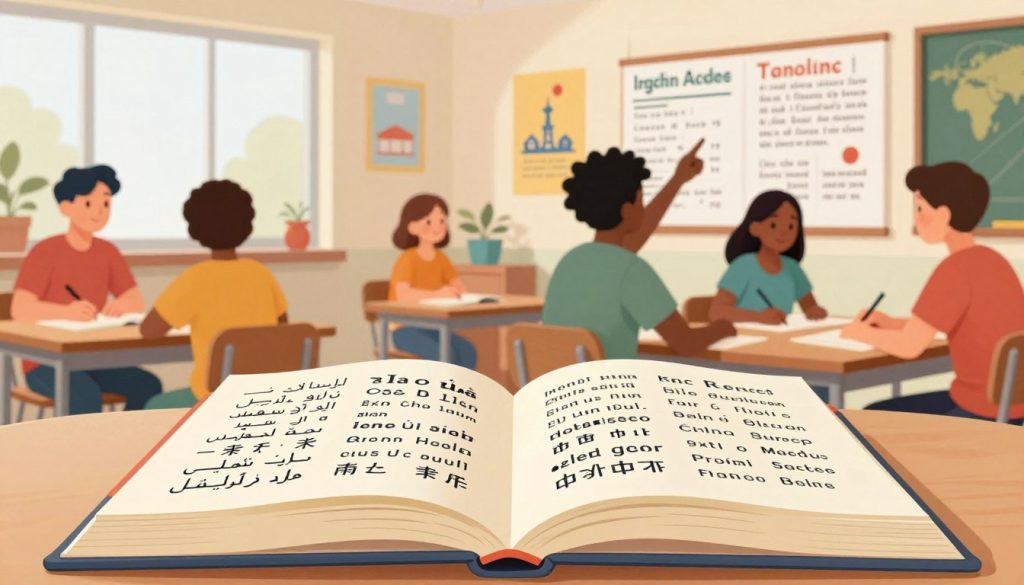
European languages: a gateway to the Western world
Including French, Spanish, Italian, Italian, and German, this group is characterized by its widespread use in international business, features of European languages:
- Ease Acquisition on learning resources.
- Similarity in grammar and vocabulary to Arabic.
- Excellent job opportunities in multinational companies.
- period Study 6-12 months to master.
Asian Languages: A Window to the East
Chinese, Korean, Japanese, and Hindi, these languages open new horizons in the world's fastest-growing economies, Characteristics of Asian Languages:
- Unique writing systems need Studying Intense.
- Rich cultures that enhance understanding of the Eastern world.
- Growing demand in the international labor market.
- period Learn Up to 18 months for full mastery.
Middle Eastern Languages: Bridges for Regional Communication
Including Persian, Turkish, and Hebrew, this group is characterized by its cultural and geographical proximity to the Arab world and the advantages of Middle Eastern languages:
- Similarity in vocabulary to Arabic.
- Strategic importance in the region.
- Promising trade and investment opportunities.
- period Study Between 4-8 months to master.
The right language is one that aligns with your personal and professional goals, we offer free consultations to help you Selection Language optimization, we study with you:
- Your professional and academic goals.
- Time Studying Available monthly.
- Resources available to each language.
- Opportunities Success Expected.
You can Learn More than Language If you have the time, we recommend starting with one language at a time until Speaking Fluently, all of our programs include Listen daily and practical conversations, this Figure From Learning Ensures Acquisition For tangible results, start your journey today and choose Language that suits your ambitions, we're here to support you every step of the way.
Developing listening skills: the foundation of effective communication
Did you know that around 45% of human communication time is spent listening؟
This percentage reflects the great importance of this skill in achieving successful and effective communication, as the absence of good listening turns the dialogue into a one-sided conversation, and effective listening is not limited to simply hearing voices, but is an active process that requires concentration, deep understanding, and the ability to analyze spoken messages and absorb them in their proper context. Specialized studies in the fields of education and communication have confirmed that poor listening skills, or dealing with them unsystematically, leads to slow learning and hinders progress in the acquisition of language and communication skills.
Strategies for developing listening skills
Here's a collection of Practical strategies which have proven effective in improving auditory comprehension skills:
-
Daily listening to original content for at least 20 minutes.
-
Use an active listening technique with note-taking.
-
Practicing repetition and chanting behind native speakers.
-
Focus on understanding the general idea before moving on to the finer details.
These strategies help build listening skills gradually and systematically, avoiding the negative effects of poor practice or relying on irregular methods, thus contributing to effective and sustainable progress in language learning.
| Level | Content type | Daily training duration | Progress rate |
|---|---|---|---|
| beginner | Children's stories and short clips | 15 minutes | 30% during the month |
| Average | News and Educational Podcasts | 30 minutes | 50% within two months |
| Advanced | Lectures and films without subtitles | 45 minutes | 70% within 3 months |
How can you train yourself to understand different accents?
Understanding different dialects requires varied exposure to audio material, we recommend starting with the standard dialect and then moving on to local dialects, practical exercises to understand dialects:
- Compare the pronunciation of the same word in different accents.
- Listen to content from multiple regions.
- Practice recognizing differences in tone and rhythm.
- Interact with speakers from diverse backgrounds.
Active listening is the real gateway to understanding different cultures.
Measuring progress on a weekly basis motivates you to keep going, take notes on your difficulties, audio aids play a crucial role in this journey, podcasts and educational videos provide continuous exposure to the language, the difference between active and passive listening lies in the degree of interaction, the first involves analysis and criticism, while the second is just listening, start your journey in developing your listening skill today, we believe that every step brings you closer to fluency.
Mastering Speaking Skills: From Theory to Practice
Have you ever felt that you know the rules well but freeze when speaking? This issue faces most students during their journey towards fluency, the transition from theoretical knowledge to practical application needs thoughtful strategies, we notice that many students face common challenges in developing conversational skills, among the most important of these difficulties is the fear of making mistakes and lack of confidence in the correct pronunciation.
Practical exercises to improve pronunciation and fluency
Here are some tried-and-tested exercises to improve your speaking skills:
- Practice pronouncing difficult sounds every day for 10 minutes.
- Audio recording and analyzing conversations with the coach.
- Practice short dialogues with native speakers.
- Shadowing is used to imitate the original pronunciation.
These exercises help build confidence gradually, and regular practice is key. Success In developing fluency.
| Type of exercise | Daily duration | Rate of improvement |
|---|---|---|
| Pronunciation of sounds | 10 minutes | 40% during the month |
| The shadow of the speakers | 15 minutes | 60% within two months |
| Practical dialogues | 20 minutes | 75% within 3 months |
How can you overcome your fear of speaking?
The fear of speaking a new language is very normal, the main reason is the fear of being judged or making mistakes, effective strategies to overcome this fear:
- Start conversations with simple, familiar sentences.
- Focus on communication, not perfection.
- Practice speaking in front of a mirror first.
- Participate in language support groups.
- We recommend starting with a specialized trainer who can help you with Evaluation Ongoing, a good trainer provides Feedback Immediate helps improve.
- Practice Conversations We recommend 15 minutes a day on a regular basis that builds confidence, 15 minutes a day of Practice The process.
- Registration Performance Audio and analyzing it on a weekly basis helps you track your progress, this technique enables you to hear your improvement in a tangible way.
- Moving from theory to practice takes patience and persistence, trust is built step by step with each successful conversation.
- Begin your journey to mastery Speaking Today, we're here to support you every step of the way.
Enhancing reading skills: from simple to complex
Did you know that Reading skill A true bridge between theory and practice?
This skill is a fundamental pillar in building comprehensive linguistic proficiency, as it plays a role in expanding vocabulary, deepening understanding, and enhancing the ability to express oneself accurately.
We note that many learners face challenges in developing reading skills as a result of relying on unsystematic learning methods, or neglecting the appropriate progression in choosing texts and levels, which leads to slow progress and difficulty in moving from basic understanding to advanced use of language.
How do you start reading simple materials and gradually progress?
The right start begins with Selection Level-appropriate materials, we recommend starting with short texts and familiar topics, an effective progression plan includes:
- Read children's comics for beginners.
- Move on to short articles with simple vocabulary.
- Practice reading the daily news at an intermediate level.
- Challenge yourself with progressively advanced literary texts
This systematic progression helps avoid the frustration of abruptly moving on to material beyond the current level, and ensures balanced and sustainable development in reading skill and effective progress in language learning.
| Level | Type of material | Daily time | Progress rate |
|---|---|---|---|
| beginner | Comic strips – Advertisements | 15 minutes | 40% during the month |
| Average | Articles – Blogs | 25 minutes | 60% within two months |
| Advanced | Books – Research | 35 minutes | 80% within 3 months |
Strategies for Understanding Complex Texts
Understanding advanced texts requires adoption Well-thought-out strategiesLanguage education specialists agree that Analytical reading It's fundamentally different from speed reading, and one of the most tried-and-true strategies:
-
Conduct a quick preliminary reading to understand the general idea of the text.
-
Identify keywords and key phrases.
-
Use smart dictionaries to understand difficult terms.
-
Analyze text structure and logical relationships between ideas.
These strategies help promote deep understanding of texts and avoid issues resulting from misinterpretation or superficial understanding, which reflects positively on the development of language skills in general. We recommend developing the skill of intelligent guessing of meanings from context, as this skill reduces excessive reliance on dictionaries.
Exercises to improve speed and accuracy include:
- Visual jumping exercises between words.
- Practice regular reading with a timer.
- Record the number of words read per day.
- Review errors and analyze their causes.
- We recommend memorizing a list of new vocabulary and reviewing it periodically.
- Aids such as online dictionaries and reading apps make the journey easier, but the most important thing is to build a daily reading habit.
- Start with 10 pages a day and gradually increase the number, continuity is the key to success in developing this essential skill.
Developing writing skills
Do you think writing is just putting thoughts on paper? In fact, this skill is the essence of effective communication in the professional world. We believe that good written expression is the passport to success in international environments. From formal business letters to creative content, the difference between a professional writer and an amateur lies in Accuracy And style.
Practical writing exercises for different levels
We offer you a step-by-step training plan that suits all levels, the basic principle is to start from easy to difficult, exercises for the beginner level:
- Write simple sentences about the daily routine.
- Describe images using 5-7 words.
- Fill in the blanks in short texts.
- Translate simple Arabic sentences.
Intermediate level exercises
- Write short paragraphs on familiar topics.
- Summarize simple news or articles.
- Writing informal emails.
- Describe personal experiences in a narrative style.
Advanced level exercises
- Write professional reports.
- Prepare professional presentations.
- Formulate detailed business proposals.
- Write creative content in a personalized style.
Writing formal and informal texts
Proper understanding of context is the foundation of good writing, each situation requires a different style.
| Type | Features | Examples |
|---|---|---|
| Official | Professional language – Complex structures – Specialized terminology | Work reports – Contracts – Academic research |
| Semi-formal | Clear language – Structured format – Balance between formality and flexibility | Emails – Presentations |
| Informal | Everyday language – short sentences – common expressions | Chats with friends – Social media posts |
Tips for improving grammatical accuracy
- Review the ground rules weekly.
- Use a reliable spell checker.
- Read aloud to catch mistakes.
- Access to model texts.
Strategies for building coherent paragraphs
- A strong beginning that expresses the main idea.
- Appropriate connectors between sentences.
- Examples and details that support the idea.
- A conclusion that summarizes the main points.
Reviewing and editing is an essential step in achieving quality, we recommend leaving the text for a while and then rereading it critically, developing a personal writing style that comes with Practice Write every day, even if only for a few minutes.
In our daily lives, we use writing in:
- Communicate with customers and colleagues.
- Prepare documents.
- Create effective marketing content.
- Document ideas and projects.
Focus on practical use in real-life situations
Did you know that approximately 90% of success in mastering any skill Depends on Practical application؟
Theoretical knowledge alone, while important, is not enough to achieve fluency or a true ability to use it effectively.
We believe that relying on theoretical learning only, while neglecting regular practice, leads to slow progress and difficulty in solidifying the acquired skills, and specialists in the fields of education and training have agreed that Continuous practical training It is the decisive factor in transforming knowledge into applicable skills.
Simulating everyday situations in the learning process
contribute Realistic situations Neglecting the applied aspect leads to poor utilization of learning and delayed progress, and examples of situations that can be simulated during training include:
-
Ordering food in a restaurant.
-
Talk to the vendor at the market.
-
Ask for directions on the street.
-
Have a simple phone conversation.
These practical exercises help to enhance understanding, build confidence in using the language naturally, and avoid issues resulting from lack of practice or reliance on theoretical learning alone.
How do you apply what you have learned in your professional life?
contribute Linking theoretical knowledge and practical application In order to accelerate the learning process and achieve more effective results, the learner needs to be exposed to realistic situations that help them build confidence and transform what they have learned into natural and confident language use.
Effective Strategies for Practical Application
| The situation | Targeted skill | Duration of exercise | Rate of improvement |
|---|---|---|---|
| Shopping | Everyday vocabulary | 20 minutes | 50% within two weeks |
| Transportation | Trend Questions | 15 minutes | 40% within a week |
| Interviews | Official speech | 30 minutes | 60% during the month |
| Meetings | Professional terms | 25 minutes | 55% within 3 weeks |
These practices contribute to an effective balance between Theoretical understanding and practical applicationIt gives the learner real experience in using the language and communicating with confidence, and practical application is the primary means of transforming theoretical knowledge into A tangible, usable skill. We recommend starting with simple situations and gradually progressing to more complex ones, ensuring a balanced and sustainable development.
Measuring progress on a weekly basis is also a motivating factor to keep going. Recording successes and challenges in each situation helps evaluate performance and identify areas for improvement. Learning from mistakes is an essential part of the learning process; every mistake is an opportunity to develop and build the skill better, start today by applying what you have learned in real-life situations, as confidence is built step by step with each successful experience.
The supportive learning environment at the academy
Have you ever imagined how the environment can transform the learning journey from challenging to fun? We believe that the right learning atmosphere is the key to success in mastering new skills. At the Science Club Academy, we create a stimulating environment that makes you feel safe and confident, an environment that helps you overcome difficulties and achieve your goals smoothly:

The role of specialized trainers in supporting the learning process
Our coaches are Heart We carefully select them to ensure quality training and ongoing support, our team has an average of 8 years of teaching experience, all of whom are certified in language. The main tasks of trainers include:
- Evaluate the initial level and design a personalized plan.
- Introduction Feedback Immediate and regular.
- Correct mistakes in a motivational way.
- Provide additional resources as needed.
We believe that the relationship between trainer and learner is essential, so we ensure constant communication and careful follow-up.
How does the study group contribute to achieving the objectives?
The study group provides strong social support, participating in Groups Learning increases enthusiasm and commitment, the benefits of group learning in our academy:
- Sharing experiences among learners.
- Practice conversation in a safe environment.
- Mutual encouragement during difficulties.
- Build a professional network.
| Group activity | Repetition | Participation rate | Impact on progress |
|---|---|---|---|
| Discussion sessions | 3 times a week | 85% | 40% improvement in fluency |
| Interactive workshops | Twice a week | 78% | 35% improvement in vocabulary |
| Collective challenges | Weekly | 92% | 50% increase in confidence |
| Group assessment sessions | Monthly | 88% | 45% performance improvement |
We measure the impact of the learning environment by
- Weekly satisfaction surveys.
- Track individual progress.
- Analyze interaction in groups.
- Evaluate improvements in confidence and fluency.
We recommend making the most of the environment by
- Active participation in all activities.
- Ask for help when needed.
- Share experiences with colleagues.
- Adhere to the class schedule.
The results show that learners in a supportive environment achieve Success Larger by 60%, confidence and continuity are key, start your journey today in an environment that motivates you to excel. We're here to support you every step of the way.
Graded training content from beginner to advanced
Have you ever wondered how a step-by-step learning plan can transform the journey to mastery from a daunting challenge to an enjoyable learning experience? The secret is Smart content design that develops gradually in proportion to the growth of the learner's skills and abilities.
We believe that neglecting the systematic progression of learning leads to slow progress and poor learning, while specialists in the fields of education emphasize that Adhere to the correct progression Protects the learner from frustration, enhances comprehension, and helps make sustainable and effective progress
Structure of the integrated educational curriculum
Our approach is based on building skills cumulatively, we start with the basics and then move to advanced levels gradually, gradual stages in our methodology:
- Foundation stage: Focus on basic vocabulary and simple grammar
- Building Stage: Developing Everyday Conversation Skills
- Expansion phase: Deepening cultural and contextual understanding
- Mastery stage: Using language in specialized contexts
This instructional design strikes an effective balance between Cognitive understanding and practical applicationIt gives the learner real confidence in using their language skills efficiently and professionally.
| Level | Training content | Duration of the investigation | Confidence rate |
|---|---|---|---|
| beginner | Basic greetings – Numbers – Colors | month | 40% |
| Average | Daily conversations – Describing places | 3 months | 65% |
| Advanced | Discussions – Presentations | 6 months | 85% |
How does the learner gradually build confidence?
Confidence is built step by step with each small success, and the learner needs repeated positive experiences to become more fluent and confident while speaking, Confidence Building Strategies:
- Like starting with simple, achievable tasks.
- Provide immediate positive feedback.
- It also recognizes small achievements.
- Gradually increase the difficulty.
We measure progress through clear criteria, each stage has specific performance indicators, and results show that learners in tiered programs achieve Retention For skills with a 70% higher rating.
Practical tips for learning foreign languages effectively
Are you looking for ways to make your language learning journey more enjoyable and sustainable? We offer proven strategies to achieve the best results.
How can you make learning fun and sustainable?
Fun is a key ingredient for sustainability, so incorporate your favorite activities into your daily routine, effective strategies to keep you motivated:
- Such as linking content to your personal interests and hobbies.
- Use interactive games and fun challenges.
- Watch movies and series in the target language.
- Listen to pleasant music and songs.
Using technology to enhance the learning process
Tech tools have become essential to progress, we recommend making the most of them, the best apps and helpful platforms:
- Vocabulary flashcard apps.
- There are chat platforms with native speakers.
- Voice recognition programs to improve pronunciation.
- Plus interactive video platforms for bases.
| Tool type | Example | Interest |
|---|---|---|
| Applications | Educational cards | Improving vocabulary retention |
| Platforms | Live chats | Speaking practice |
| Tools | Recognize my voice | Pronunciation correction |
We believe that unsystematic learning and the absence of clear planning are among the most prominent factors that hinder progress and delay reaching the required level of mastery, hence our methodology that transforms educational challenges into real opportunities for growth and development, our mastery journey with us is based on combining sound cognitive foundations and real-life practical training, giving you the confidence and ability to use the language fluently in various situations.


No comment