


The Scientific Club Academy realizes that mastering digital tools is what distinguishes the modern researcher, so we provide you with an intensive training program that helps you understand complex statistical concepts and apply them practically using the latest international software adopted in academic research and professional projects, and thanks to our experts you will gain the ability to choose the appropriate statistical test for your type of data, which increases the reliability of your results and gives you full confidence when presenting your conclusions before prestigious scientific committees with all the prestigious scientific committees.
Teaching statistical analysis programs
This skill is a necessity in the era of big data, as it aims to enable the trainee to extract patterns and relationships between variables in a sober scientific manner, and adhering to the path of learning statistical analysis programs helps in simplifying long calculations and reducing human error rates, which ensures accuracy in formulating the final results of research, and familiarity with these programs opens wide horizons for researchers and entrepreneurs to understand various phenomena and predict future trends based on strong digital evidence, and in Science Club Academy In our curriculum, we focus on linking theory and practice, to ensure that the trainee has a critical analytical vision that enables them to interpret data with intelligence, depth, and objectivity, in addition to technical skill.

Learn statistical analysis programs step by step
We adopt a step-by-step methodology that ensures that the trainee absorbs all aspects of statistical programs through the following points:
- Start with the data processing and cleaning phase to ensure that there are no outliers or errors that may affect the accuracy of subsequent analyses.
- Familiarize the trainee with how to enter data and code variables correctly according to the requirements of each statistical program used in the training.
- Explain the types of tests and how to choose the most appropriate ones based on the nature of the research hypotheses and the type of sample selected for the current study.
- Training on the extraction of frequency tables and explanatory graphs that highlight the results in a visually appealing and easy-to-understand manner for both the reader and the arbitrator.
- Conducting practical applications on real models to ensure that the trainee is able to handle real-life data challenges in their own research with confidence and technical proficiency.
Using SPSS, Excel, and R for research
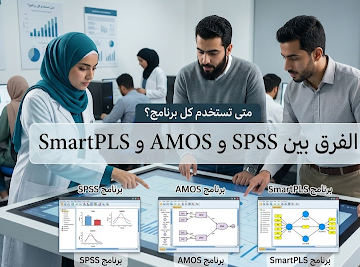
There are many tools available for analysis, but SPSS remains the most famous program in the social sciences for its easy interface and the strength of its tests, while Excel is the ideal tool for organizing raw data, and on the other hand, we provide training on the R language for researchers wishing to conduct advanced analyses and customized software, the combination of these tools gives the researcher high flexibility in dealing with different data sizes and various statistical complexities, and in Science Club Academy We help you select the most appropriate tool for your project, with a focus on producing accurate software outputs that comply with the requirements for publication in international scientific journals that require strict standards in the presentation of statistical data and illustrations.
Read more:Statistical Analysis Master's Thesis Your Ultimate Guide to Grabbing an A
How to analyze quantitative data
Working with numbers requires high accuracy, which is why our programs focus on teaching trainees the following:
- Understand measures of central tendency such as mean, median, and mode, and how to use them to describe the characteristics of a research sample in a statistically accurate and concise manner.
- Calculate measures of dispersion such as standard deviation and variance to estimate how homogeneous the collected data is and how well it represents the original population from which the study was drawn.
- Conduct correlation and regression tests to examine the relationships between independent and dependent variables, and determine the extent to which each of them affects the final results of the existing scientific research.
- Check the P-value of the results to ensure that the conclusions are not purely coincidental, but are based on statistically and logically valid and robust numerical data.
- Drafting statistical tables according to the APA system or the required academic systems, and writing a thorough analytical commentary that emphasizes the importance of the extracted figures and their deep scientific meanings.
Interpretation of statistical results
Therefore, our statistical analysis software education focuses heavily on the skill of analytically reading the Outputs, and we teach you how to turn deaf tables into scientific storytelling that cleverly proves or disproves research hypotheses while comparing your results with previous studies to highlight the added value of your work. Correct interpretation requires a deep understanding of the statistical meaning of each test, which we are keen to instill in the mind of the trainee to be able to defend his conclusions during the discussion, and help avoid wrong readings of the data, which ensures that you present a sober research characterized by objectivity and high professionalism that befits your academic and professional status.

Hands-on training on analysis programs and their importance
The practical aspect is the true essence of our programs, and the importance of hands-on training is highlighted by the following points:
- Enabling the trainee to face sudden technical issues during analysis and how to address them on their own without the need for constant and costly external assistance.
- Enhance the skill of accuracy and observation when reviewing statistical outputs, reducing the chances of typographical or numerical errors in the final version of the scientific research.
- Increased speed in accomplishing analytical tasks, allowing the researcher more time to focus on the theoretical aspect and philosophical discussion of the results of their academic and professional study.
- Acquire the skill of reading and understanding published statistical reports, which raises the level of the trainee's research culture and makes him aware of the latest trends in his specialty.
- Build a portfolio of real analytical projects that the intern has completed, which will bolster their resume in a job market where these skills are in high demand.
Read more:How does the Academic Presentation Skills course take you to the top of your game?
Our services for teaching statistical analysis programs
We provide integrated services that meet the needs of all researchers and professionals:
- Specialized SPSS training courses from beginner level up to advanced analytics and complex structural modeling Amos.
- Intensive workshops to learn the art of analyzing data and extracting professional reports using Excel for researchers and employees in various administrative and commercial sectors.
- One-on-One counseling sessions to help researchers apply statistical analysis to their own data and resolve issues they may suddenly encounter.
- R language and statistical programming courses for researchers in the scientific, medical, and big data fields that require high programming accuracy and advanced visualization options.
- The service of reviewing ready-made statistical analyses and ensuring their validity and conformity with the hypotheses, and providing a detailed report with proposed amendments to raise the quality of scientific work.
Frequently asked questions
Do I need a strong math background to learn statistical analysis?
Our programs do not require a complex mathematical background, we focus on how to use the programs and interpret the results logically while simplifying the basic statistical concepts that every researcher in the humanities and applied sciences needs.
Can I get a certificate after completing the training?
The Scientific Club Academy awards a certificate of completion for the training programs, which reflects your mastery of statistical analysis skills on the specific programs, strongly supporting your academic and professional profile when applying for jobs or grants.
Which program is better for my research, SPSS or Excel?
It depends on the nature of the data; Excel is excellent for organizing simple data, while SPSS is preferred for complex statistical analyses and advanced testing in academic research, and we help you choose the most appropriate tool for your particular research topic.
Teaching statistical analysis programs is our commitment to develop your research skills to enable you to reach the most accurate scientific results in a modern and professional manner that is unparalleled in the always outstanding Scientific Club Academy.


No comment