

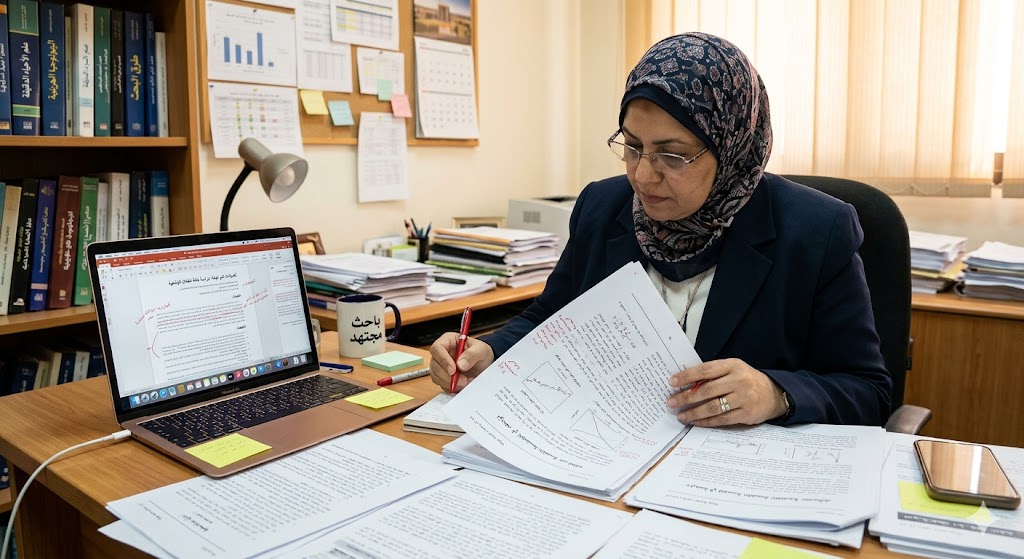
Mastering the review of scientific papers is a crucial skill for every researcher who seeks to publish his studies in prestigious journals, the path to academic success requires meticulous accuracy and strict adherence to the global standards imposed by arbitration committees, many researchers face great challenges in coordinating their research and drafting it in a professional manner that reflects the value of the effort made in it, through this article, we will provide you with proven strategies to help you overcome the obstacles to academic publication, starting from the structure of the research to the final touches.
The importance of conducting a literature review for researchers
Evaluative steps play an essential role in the career of any academic who seeks to prove his competence in the research community. Careful examination of written content and review of scientific papers ensures that the work is free of methodological gaps that may lead to its rejection by the competent committees, and here the importance of comprehensive scrutiny emerges that enhances the strength of the arguments and proofs presented, and emphasizes the originality of the idea and its suitability for the objectives of the targeted journal. This procedure helps to discover logical inconsistencies or deficiencies in data collection, giving the writer an opportunity to correct errors before the official submission, and continuous scrutiny contributes to refining the writer's skills, as he learns from his repeated observations how to build a coherent and attractive scientific narrative for the reader.
Professional paper review services
Progress Science Club Academy Comprehensive support for researchers and reviewing scientific papers to ensure the quality of their research and its compliance with international standards, these services include a set of procedures designed to improve the quality of writing:
- Careful content analysis examines the essence of the research to ensure that the ideas are coherent and logically sequenced, ensuring a strong and impactful scientific addition that attracts the attention of the judging committees.
- Checking the scientific methodology We check the validity of the instruments used in the study and their suitability to answer the questions, while emphasizing the validity of the conclusions drawn from the data.
- Formatting the overall structure The research chapters are arranged according to the requirements of the target journals, to ensure smooth reading and easy tracking of information by reviewers.
- Evaluating novelty and originality We focus on highlighting the innovative aspect of the study, and making sure that previous ideas are not repeated, which enhances the chances of publication in scientific platforms with a high impact factor and prestigious value.
Read more:Getting your dissertation accepted starts with mastering the draft
How to correct research terminology
The accurate use of specialized vocabulary is an essential pillar to ensure the success of any academic effort, correcting the terminology of the work requires extensive knowledge of the dictionary adopted in each field, as a simple mistake in choosing a word may completely change the intended meaning and affect the credibility of the study, so reviewing scientific papers is important, and the writer must always return to specialized dictionaries and reliable previous research to ensure the accurate translation and the correct concept of each expression used, and standardizing expressions throughout the text contributes to creating a smooth flow that facilitates the reader to absorb complex ideas without distraction, it is also necessary to avoid verbal filler and replace the.
Read also

How to effectively analyze research content
Deep evaluation of studies requires systematic strategies that deconstruct the text into its basic elements to understand its multiple dimensions. The systematic deconstruction of academic works helps reveal the true value of the information:
- Identifying the central idea The work begins with understanding the main objective of the study and how clear it is from the beginning, which helps in assessing whether the writer has stuck to his or her course or deviated into unwarranted side issues.
- Examining the strength of arguments The evidence and proofs used to support hypotheses are scrutinized to ensure that they are based on reliable sources and accurate data that are not subject to doubt or misinterpretation by readers.
- This aspect focuses on the clarity of the graphs and tables, and their compatibility with the textual explanation, to ensure that the conclusions are communicated in a simple and direct way that serves the research objectives and answers the research questions clearly.
- Linking the conclusions to the introduction Ensure that the conclusion provides adequate answers to the question posed at the beginning, and that there is a logical sequence linking all parts of the study to form a coherent and interconnected structural unit.
Read also:Choose a comprehensive master's thesis revision service
Organize references properly
The list of sources is one of the most important parts that reflects the integrity of the writer and the depth of his research, the organization of references requires following internationally approved standard systems such as the American Psychological Association system or the Harvard system, according to the requirements of the publisher, and accurate documentation ensures the protection of the intellectual property rights of others and gives your study high credibility in front of the jury, and attention must be paid to accurate details such as the year of publication, author names, and page numbers, as any defect in this data may lead to the exclusion of the entire work, as the alphabetical or digital arrangement of the sources made it easier for readers and reviewers to return to them to verify the information, as well as to verify the information.
Proofreading of scientific papers
The integrity of language is the pillar that carries complex ideas and communicates them clearly to the recipient. Reviewing scientific papers involves several levels of examination to ensure that the text is free of any impurities that may hinder full understanding and comprehension:
- Correct spelling errors Every word is reviewed to ensure that it is spelled correctly, as minor errors leave a negative impression of the writer's seriousness and reduce the professionalism of the work submitted to the evaluation committees.
- Adjust grammar rules to ensure that sentences are properly structured and that verbs and nouns are compatible, which gives the text the strength and sobriety worthy of the academic level required in international journals with a prestigious reputation in the specialty.
- Improve punctuation Use commas and periods in the right places to organize breath and break up long ideas into digestible units, making it easier for reviewers to follow a logical narrative without feeling overwhelmed.
- Eliminate redundant sentences that do not add real value to the meaning, and focus on brevity and clarity in communicating the scientific message in as few words as possible.
Improving academic writing style
Good work is not limited to the correctness of information, but extends to the way this information is presented, improving the narrative style requires moving from everyday language to a formal language characterized by objectivity and complete neutrality, the writer must avoid using personal pronouns that suggest bias, and rely instead on passive forms, the choice of strong and accurate synonyms contributes to enriching the text and giving it a sober character that reflects the depth of the writer's specialization, attention must be paid to varying the length of sentences to create a comfortable reading rhythm that does not bore the recipient, the logical interconnection of paragraphs and the use of appropriate transitional words ensure the flow of ideas Attention should be paid to varying the length of sentences to create a comfortable reading rhythm that does not bore the recipient, the logical connection between paragraphs and the use of appropriate transition words ensures the flow of ideas in a smooth manner, this linguistic refinement represents the essence of excellence in any work that aspires to reach the world, which is exactly what we focus on training him step by step through the explanations and interactive courses available through the Scientific Club Academy.
Mistakes when reviewing academic papers
Many people fall into hidden traps while preparing their final papers, which leads to disappointing results, through ScienceClub, we monitor the most prominent lapses that should be avoided to ensure a successful and fruitful publishing experience, including:
- Ignoring publication guidelines Failure to adhere to each journal's specific requirements, such as font type, size, and word limits, is one of the fastest ways to reject work, even if the scientific content is excellent and valuable.
- The superficiality of the presentation is limited to listing information without providing deep critical analysis, which makes the study look like a mere compilation of data rather than an innovative addition to knowledge that deserves attention and appreciation.
- Weak conclusion Writing conclusions that are not closely related to the results of the study, or making general and inapplicable recommendations, which weakens the final impact of the research and reduces its practical usefulness to society.
- Relying on outdated sources Citing outdated research in rapidly evolving fields gives the impression that the author is not up to date with the latest developments and vital developments in his/her field of specialization.
Frequently Asked Questions
What is the importance of formatting references?
Coordinated referencing protects intellectual property rights and demonstrates the author's familiarity with previous literature, which increases the credibility of the work in front of evaluation committees and increases the chances of publication in major international journals.
How long does the academic evaluation process usually take?
The duration varies depending on the journal and specialty, but usually ranges from weeks to several months. The key is to submit an error-free version to speed up the process and avoid repeated edits from referees.
Is proofreading necessary before submitting?
Of course, grammatical errors can lead to immediate rejection, even if the idea is strong and innovative. Proper language reflects professionalism and makes it easier for judges to understand the finer details efficiently.
Conducting a thorough literature review is not just a routine step, it is a real investment in your career, and your path to prestigious publication is paved, so don't hesitate to join our courses today through the Science Club Academy to develop your skills.
No comment