

Best Python learning path for data science researchers in 2026
The best path for data scientists to learn Python begins with understanding that this journey is no longer a secondary option, but a strategic necessity in an era where decisions are measured by the power of data. With the rapid acceleration in artificial intelligence technologies and the growing reliance on advanced analytics, Python has become the central language that connects data, models, and intelligent applications.
Although tools capable of generating codes automatically are widespread, the real value lies in the ability to interpret, improve, and use the code to solve real-world problems efficiently, in line with the requirements of practical reality, highlighting the importance of following a clear and systematic learning path that balances fundamentals with practical application and shortens time without compromising the quality of understanding, to reach a truly professional level.
The Best Path to Learn Python for Data Scientists
Python is a high-level, multipurpose programming language characterized by a simple, readable structure that supports several programming styles such as object-oriented, procedural, and functional. It is widely used in fields such as software development, data analysis, artificial intelligence, and task automation thanks to its rich ecosystem of libraries and tools.
Although artificial intelligence tools that can write codes are becoming more widespread, relying solely on them is not enough, as the codes produced by these tools are often superficial or riddled with minor errors. Moreover, most companies do not allow the use of artificial intelligence tools during technical interviews, making mastering Python an absolute necessity for securing a job in the field.
The professional learning path includes:
- Preparing the working environment.
- Learn the basics of Python.
- Basic data science libraries.
- Learning through projects.
- Developing advanced skills.
- Data structures and algorithms (DSA).
- Specialization in data science.
Preparing the working environment
Before starting to learn Python, it is essential to set up a suitable working environment that enables you to write and run codes efficiently. Choosing the right environment affects the ease of learning and also reflects on productivity and understanding of technical details. At this stage, there are two main options you can rely on:
| Notebook environments | Professional development environments |
|
|
Choosing the tool should not be an obstacle in the best path for data science researchers to learn Python; the most important thing is to actually start writing code and implementing practical applications; you can switch between tools later as your level improves.
Learn the basics of Python
The Python basics learning phase represents the cornerstone of the best path for data science researchers to learn Python; it is the most difficult phase, as it moves from a theoretical level of knowledge to practical programming understanding.
At this stage, the learner begins to think in a logical and organized manner; this transformation requires time and continuous practice, which requires commitment to daily training and gradual learning to successfully overcome this stage; during this period, focus must be placed on mastering the following concepts:
| Variables and data types | They understand how to store data and handle different types such as numbers/texts/logical values. |
| Logical operations and comparisons | Using logical factors to make decisions based on specific conditions |
| Conditional sentences (if / else) | Building the logic of program flow according to different inputs and scenarios |
| Loops (for / while) | Executing repetitive operations efficiently without the need to rewrite the code |
| Functions | Organizing the code into reusable units to improve efficiency and clarity |
| Infrastructure | Working with data sets in flexible and organized ways, including (Lists, Dictionaries, Tuples) |
| The Object-Oriented Programming (Classes) | Building more complex and scalable models using objects |
| Managing libraries (Packages) | Importing and using external tools to expand the capabilities of Python |
Mastering these concepts aims to learn the language and build a programming mindset capable of analyzing problems and transforming them into practical solutions, as these fundamentals constitute the backbone of any application in data science.
Basic Data Science Libraries
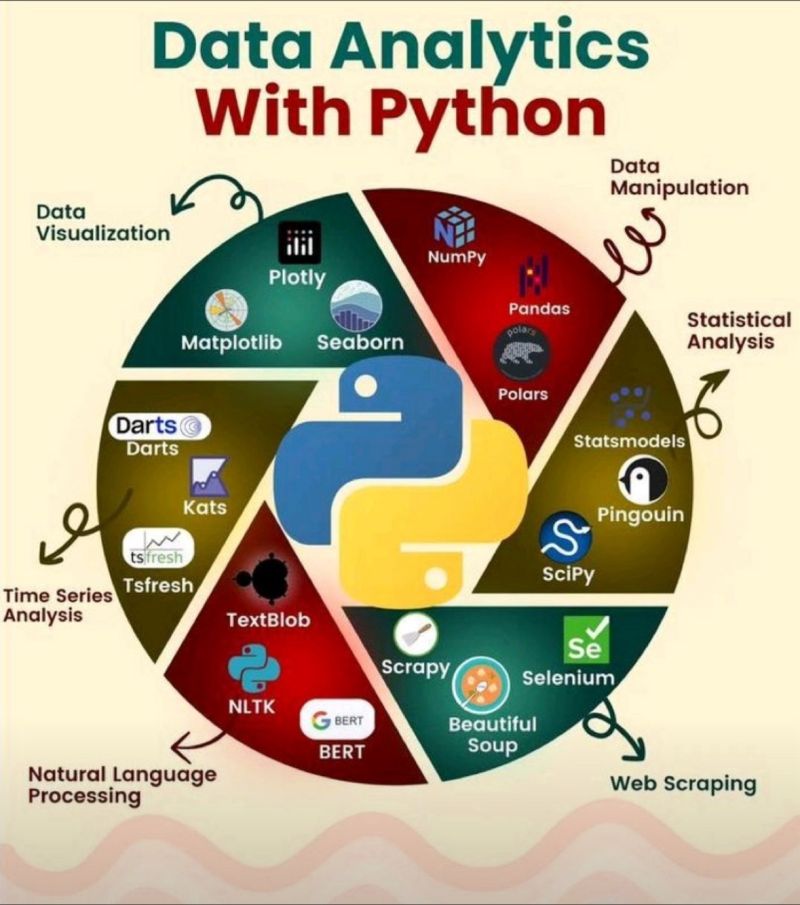
This stage in Python learning for data scientists is practically used in professional work environments. These tools not only facilitate code writing, but also represent the infrastructure upon which analytical processes, modeling, and extracting insights from data are built.
At this stage, focusing is practically possible by directly applying real data to understand how to employ each library efficiently.
The list of the most important libraries includes:
| NumPy | The mathematical foundation of data science, where efficient structures are provided to handle multidimensional matrices and execute computational operations at high speed, is the foundation upon which most machine learning algorithms rely. |
| Pandas | A pivotal tool for data processing and analysis, it allows for the easy handling of DataFrames, performing efficient cleaning, filtering, and transformation operations, making it indispensable in any data project. |
| Matplotlib | A library specialized in data visualization helps convert numbers into clear graphs, making it easier to discover patterns, trends, and relationships within the data. |
Learning through projects
Project-based learning is one of the most effective methods for a beginner’s Python learning path, as projects put you in front of real challenges that require data analysis, decision-making, and building implementable solutions.
This type of learning reflects the actual working environment, and provides practical experience that cannot be gained through theoretical study alone; it highlights the importance as follows:
- Solve real-world problems that enhance the ability to think practically and handle imperfect data.
- Quickly identify weaknesses to improve skills and address gaps in understanding.
- Developing analytical and creative thinking through seeking multiple solutions and evaluating the best ones.
Developing advanced skills
This phase in the best path for learning Python for data scientists includes:
- Managing codes using Git to track changes and organize work professionally.
- Using GitHub to showcase projects and build a strong portfolio reflects skills.
- Managing Python releases using tools like PyEnv to ensure project compatibility.
- Library management: Through tools like pip or poetry to control dependencies.
- They understand the basics of deployment to move projects from the development phase to the production environment.
- Learn to use Generators to improve performance and efficiently handle large data sets, Decorators to add additional functionality to code in an organized way, and Lambda Functions to write concise and efficient functions.
- Advanced object-oriented programming for building scalable and reusable systems.
- They understand the basics of cloud services such as AWS, which are used to store data, run models, and deploy applications on a large scale.
Specialization in Data Science
After building a strong foundation in programming and tools, you can specialize in different fields of data science, according to your interests and intended career path, this includes:
| Data analysis |
|
| decline |
|
| Classification |
|
| Unstructured learning |
|
| Natural language processing |
|
Science Club Academy of the Club
Offer AScience Club Academy An integrated course for learning Python in data science, designed to transform the learner from a beginner to a professional in a practical and systematic way.
- Gradual learning begins with the basics of Python and continues with advanced specialization.
- Practical training on data science libraries such as NumPy, Pandas, and Matplotlib.
- Implementing realistic projects to build real-world application experience.
- Training in Git, GitHub, Deployment, and AWS.
- Training on data structures and algorithms for interviews.
- Specialization in data analysis, classification, regression, and NLP.
The academy focuses on application and building a professional portfolio that qualifies you for the data science job market.
Try the Free Statistical Lab
Test your questionnaire's reliability (Cronbach's alpha), run an item analysis and get descriptive statistics for your variables for free, with the results explained in Arabic and English.
Frequently asked questions
What is the most important step in starting to learn Python for data science?
Create the appropriate work environment and start writing the code immediately, because practical application is the most important factor in accelerating learning and building true understanding.
What is the role of Python libraries in data science?
Powerful tools are provided for data processing, analysis, and visualization, such as NumPy, Pandas, and Matplotlib, which facilitate the extraction of insights and the building of models.
Why is learning through projects considered necessary?
Because it mimics the real work environment, develops problem-solving skills, reveals weaknesses, and helps build a strong portfolio.
The Science Club Academy Academy provides the best path for learning Python for data scientists, through a smooth transition from concepts to application.
A Researcher's Guide to Mastering Quantitative Data Analysis
SPSS Tutorial for Beginners Step by Step
From zero to professional your journey inside the data analytics workshop






No comment