


When analyzing data statistically, it is not enough to pick a statistical test at random; you first need to understand the nature of the data and whether it meets the test’s assumptions. This is where understanding Parametric and Nonparametric Testsmatters: the difference between them, and when each type is the better choice for accurate and reliable results.
What Are Parametric Tests?
Parametric tests are statistical tests that rely on a set of assumptions about the distribution of the data. The most important is that the data is normally distributed in many cases, along with the level of measurement and homogeneity of variance, depending on the test used.
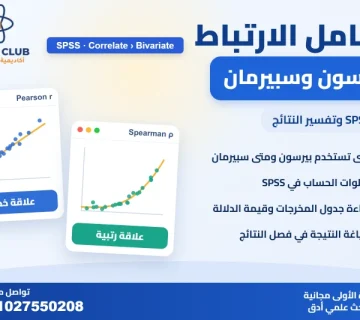
The best-known parametric tests include the T-test, analysis of variance ANOVA, and the Pearson correlation coefficient Pearson Correlation.
These tests have high statistical power when their assumptions are met, which is why they are widely used in scientific, medical, social and educational research.
What Are Nonparametric Tests?
Nonparametric tests do not depend as heavily on assumptions about the distribution of the data, so they can be used when the normality assumption is not met or when the data is ordinal or nominal, depending on the appropriate test.
Examples include the Mann-Whitney U, the Wilcoxon, the Kruskal-Wallis, and the correlation coefficient Spearman.
Nonparametric tests are a good option in many cases where the sample is small or the data does not meet the assumptions of parametric tests.
The difference between parametric and nonparametric tests
The main difference between Parametric and Nonparametric Tests lies in the assumptions each type relies on. Parametric tests often require certain conditions, such as the distribution of the data and homogeneity of variance, while nonparametric tests are more flexible about the shape of the distribution.
However, using a nonparametric test does not mean it is always better. If the conditions of the parametric test are met, it may be more powerful and better able to detect differences or relationships in the data.
How Do You Choose the Right Statistical Test?
To choose the right test, start by identifying the type of variables and their level of measurement, then define the goal of the analysis: do you want to compare two groups? More than two groups? Or study the relationship between two variables?
Next, check the assumptions of the parametric test, such as testing the normality of the data and homogeneity of variance when needed. If the conditions are met, you can use the appropriate parametric test; if they are not, or the nature of the data does not suit it, a nonparametric test may be the better choice.
For example, a t-test can be used to compare the means of two independent groups when its assumptions are met, while Mann-Whitney can be used when the parametric test is not suitable. Similarly, Pearson can be used to study correlation when its conditions are met, while Spearman is used in cases suited to ordinal or non-normal data.
Why Should the Test Be Chosen Carefully?
Choosing the statistical test correctly directly affects how the research results are interpreted and how sound the conclusions are. Basing the choice on the nature of the data and the study objectives, rather than on the most popular test, helps the researcher reach more accurate and objective results.
It is also important not to rely on the result of a single test without fully understanding the nature of the data and the assumptions of the statistical analysis.
Not sure which test to use? Try the free wizard
Answer short questions about your study aim and your data, and the wizard suggests a suitable test, where to find it in SPSS and its assumptions, with a ready methods paragraph.
Frequently Asked Questions About Parametric and Nonparametric Tests
Are nonparametric tests better than parametric tests?
Not necessarily. The choice depends on the nature of the data and whether the test assumptions are met. If the conditions of the parametric test are met, it may be the statistically stronger option.
When should I use the Mann-Whitney test?
The Mann-Whitney test is used, where appropriate, to compare two independent groups when the assumptions of the independent-samples t-test are not met, or when the data is ordinal, depending on the nature of the study.
How do I know which statistical test is right for my research?
Start by defining your research question, the type of variables, the number of groups and the nature of the data, then check the test assumptions. You can also get help from a statistics specialist to choose the most suitable test and interpret the results correctly.
Understanding Parametric and Nonparametric Tests helps the researcher make a sound statistical decision that fits the nature of their data and the objectives of their study. No single test suits all research; the right choice depends on the type of data, the number of groups, the conditions of the analysis and the research question. That is why these factors should be considered before starting the analysis, to ensure accurate and reliable scientific results.
Parametric tests, nonparametric tests, statistical tests, choosing a statistical test, statistical analysis, t-test, Mann-Whitney test, ANOVA, Spearman test, Pearson test.







No comment