
Write a professional abstract to attract readers and searchers to your business
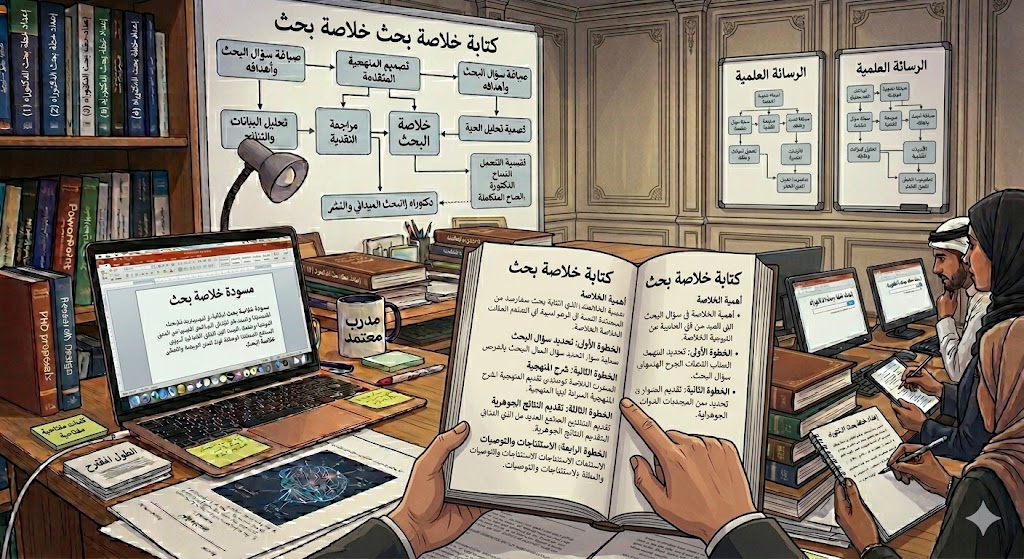
The skill of writing a professional research abstract is the real interface that reflects the value of your academic effort and determines the reader's first impression of your study, not only in terms of shortening pages, but also in crafting a coherent narrative that combines scientific accuracy and natural linguistic flow.
A successful abstract is one that gives the reader the essence of the idea clearly without complexity or boring repetition, and by following the rules of proper drafting, you can turn that small part into a powerful tool that highlights the uniqueness of your research and makes it a guaranteed reference in your scientific field, which guarantees your work acceptance and spread.
How to write an effective abstract
There are a number of steps to follow when writing a research abstract:
Read the entire paper carefully
Before starting to write a sober research summary, you must re-read the research thoroughly and comprehensively, starting from the introduction to the conclusion, as this step aims to grasp the organizing thread that connects the parts of the study to each other, and the summary is not considered a mere compilation of sentences, but rather a process of rewriting a focused intellectual style that needs a deep understanding of the content before condensing it into a few lines.
Identify the key elements of the research
The quality of writing a professional research abstract depends on the accuracy of extracting the main pillars on which the abstract will be based, as the researcher here must clearly define the title of the study and its field, while highlighting the central issue and the objectives it seeks to achieve, as these points form the skeleton of the abstract and without their clear appearance, the abstract loses its basic function as an introductory interface for the study.
Start writing in short form
The moment of drafting the first draft comes, where the researcher's skill in balancing between brevity and comprehensiveness emerges, as the process of writing a successful research summary needs to adhere to a specific size, mostly between 250 and 300 words, with the use of direct and condensed scientific language, and at this stage, all secondary details are excluded so that each written word becomes an added knowledge value that serves a specific purpose without prolonging the distraction of the reader.
Tapg more:Reviewing a scientific paper with the steps of academic quality and publication of studies
Consider the logical order of the content
The information in the abstract should flow in a logical sequence that ensures ease of understanding, as the researcher starts with a brief introduction that clarifies the background of the topic, and then moves on to present the issue and objectives to the methodology followed, as this methodological arrangement makes the process of writing the abstract more clear and attractive, which allows the reader, even if he is not a specialist, to easily grasp the value of the research work and the results it has reached.
Make your research first impression unforgettable, get a professional and impactful research abstract writing service with experts Science Club Academy.
How to summarize research content in an organized way
You can summarize the content of the research by following the following structured steps:
Extracting Important Results
Writing a research summary is incomplete without clearly indicating the final fruit of the study, as the researcher must select the most essential results and present them directly. The summary does not include all the numerical details or complex analyses, but rather focuses on the critical answers and extracting results provided by the research to the questions posed.
Formulate clear recommendations
Writing recommendations in the abstract adds an applied value that enhances the integrity of the work, as the abstract aims to guide readers and researchers on how to benefit from these results, and this is done through focused sentences that open new avenues for future studies or provide practical solutions to the issue addressed in the original study.
Review the abstract before submission
A final review of the abstract is the safety valve that ensures that the abstract is free of linguistic errors or scientific lapses. The process of writing the abstract is not complete except by reading the text with a critical eye a day or two after writing it to ensure that the ideas flow harmoniously and make sure that the abstract represents the research accurately and faithfully.
At the Scientific Club Academy, we have mastered the art of intensifying scientific effort, as we guarantee you to write a research summary with scientific accuracy and sober language worthy of your studies.

The place of the abstract in scientific research
Writing an abstract is the first strategic step, as it is placed in the opening pages of the study immediately after the title page, and the position of the abstract is as follows:
- University theses have a separate page titled Abstract that comes right after the thesis cover to serve as the main entrance to the content.
- Peer-reviewed articles The abstract appears immediately after the title and author's name, followed by keywords for easy indexing and access.
- Conference papers are often submitted as a separate item for preliminary approval and are published in the conference brochure.
- Scientific posters are placed at the top of the design to grab visitors' attention and quickly get to the heart of the research.
- Applied reports are highlighted as an executive summary on the first pages, with a heavy emphasis on final results and practical recommendations.
Increase your chances of being accepted for publication in international journals, all you have to do is order an effective and certified abstract writing service through Science Club Academy.
Common mistakes when preparing an abstract
Writing a professional research abstract is the first gateway through which the value of your scientific study is expressed to the mind, and common mistakes in the abstract are as follows:
- Exceeding the limit undermines the value of writing a solid research abstract, as you must adhere to intelligent brevity that does not compromise the essence of the scientific content.
- The use of loose sentences also reduces the professionalism of the work, as the key to writing an outstanding abstract is to rely on straightforward accuracy without embellishments.
- The absence of elements such as issue or methodology is a major mistake, as writing a comprehensive research abstract should clearly reflect the overall structure of the study.
- The academic style also avoids the formulas of I did or we did, as writing an objective research summary requires phrasing sentences in a neutral and professional manner.
- A common mistake when writing an abstract is to include documentation or sources within the abstract, as the professional rules of writing a proper abstract forbid this.
Do not compromise on the interface of your research and do not worry about common errors, do not hesitate and trust our team's skill in writing a scientific and integrated research abstract, in addition to being error-free.
Frequently asked questions
What is the ideal length when writing a research abstract?
The universally accepted length ranges from 150 to 300 words, and you must adhere to the limit imposed by the academic body or journal.
Should references be included in the abstract?
No, the rules of writing a professional research abstract require it to be completely devoid of any citations or references, as it expresses only the essence of your current study.
The skill of writing a solid research abstract remains the bridge between your scientific effort and the interest of the reader, as it is not considered a mere abbreviation of words, but rather an intelligent and professional extraction of the essence of knowledge. Investing time in drafting an accurate and organized abstract ensures that your study is accepted and spread in academic circles, and also reflects the extent to which the researcher has mastered your methodological and linguistic tools.





No comment