


SPSS statistical analysis is an essential and indispensable step in scientific research and master's and doctoral theses, as it helps the researcher to transform raw data into accurate results that support hypotheses and enhance the credibility of the research. With the increasing requirements of scientific publishing, relying on professional statistical analysis has become a necessity rather than an option, and here the Scientific Club Academy emerges as a specialized platform that provides integrated academic support and statistical analysis services using SPSS according to the highest scientific standards to help researchers achieve reliable results and increase the chances that their research will be accepted with confidence.
SPSS statistical analysis steps from data entry to results

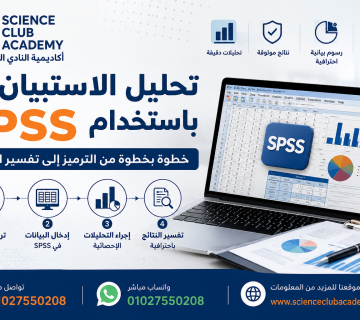
SPSS analysis of research is one of the most important stages that ensure the accuracy of the results and the validity of scientific conclusions, as it helps the researcher to understand the data and transform them into digital indicators that support the objectives of the study, and the success of implementing SPSS analysis depends on following accurate methodological steps starting from data entry and ending with drawing conclusions and interpreting them in a scientifically correct manner through the following steps:
- The process of doing SPSS statistical analysis starts with entering the data in an organized manner with variables, their type, and value labels to avoid errors later on.
- The data is examined for missing or illogical values, which is a necessary step before any analysis is carried out.
- The implementation of SPSS analysis depends on the nature of the study, whether the analysis is descriptive or inferential with the selection of the most appropriate statistical test.
- Run the analysis using SPSS at this stage to apply statistical tests and extract tables and numerical results.
- Interpreting statistical results SPSS analysis of research is not just about numbers, but about interpreting the results and relating them to the research hypotheses.
- Results Presentation and Scientific Writing The results of the SPSS statistical analysis work are presented in clear tables and graphs with a scientific explanation that supports the quality of the research.
Types of SPSS statistical analysis used in scientific research
SPSS statistical analysis is one of the main pillars of scientific research, as it provides accurate tools that help the researcher to understand and analyze the data according to an approved scientific methodology, and the choice of the type of analysis depends on the nature of the study and its objectives, as each type is used as follows:
- Descriptive statistical analysis is used to summarize data and display its basic characteristics such as arithmetic mean, standard deviation, and percentages.
- Inferential statistical analysis aims to test hypotheses and draw conclusions that are generalizable to the study population.
- Analysis of statistical differences is used to compare means between two or more groups using tests such as T-test and ANOVA.
- Correlation analysis shows the nature and strength of the relationship between research variables.
- Regression analysis
It is used to study the effect of independent variables on the dependent variable and predict the results. - Reliability and validity analysis is applied to measure the reliability and validity of research tools, especially questionnaires and scientific scales.
Read more: The importance of performing statistical analysis and interpreting the Saudi results
The difference between descriptive and inferential analysis in SPSS
The difference between descriptive and inferential analysis is the cornerstone of any statistical research done in SPSS. In short, the first tells you what happened in the sample, and the second tries to predict what will happen in the larger population:
| Comparison | Descriptive Statistics | Inferential Statistics |
| Primary goal | Summarize, organize, and simplify data to describe the characteristics of the study sample. | Make conclusions and generalizations about the community based on the results of the sample. |
| What does it cover? | It describes the data you have here and now. | Predicts results and tests hypotheses (is there a correlation or difference?). |
| The most important scales | Arithmetic mean, median, mode, standard deviation, frequencies. | t-test, analysis of variance (ANOVA), Pearson correlation coefficient, regression. |
| Final result | Frequency tables, Bar chart, Pie chart. | The probability value (P-value) to determine the statistical significance of the results. |
| Using it in SPSS | Analyze then Descriptive Statistics. | List Analyze Then Compare Means Or Correlate Or Regression. |
How to choose the right test when doing SPSS statistical analysis
Choosing the appropriate statistical test is a pivotal step in analyzing data using SPSS, as it directly affects the accuracy of the results and the validity of scientific conclusions, and the proper use of SPSS in university theses ensures that the research adheres to academic standards, as the appropriate test is chosen according to the following:
- Determine the goal of the study and whether describing, comparing, or testing the relationship is required.
- Know the type of quantitative or descriptive variables before choosing the appropriate SPSS statistical tests.
- Specify the number of groups or variables to be analyzed.
- Check statistical test conditions such as normal distribution and homogeneity of variance.
- Choose a test that matches the nature of the data and the research objectives.
- Relying on scientifically accurate interpretation of SPSS results and linking them to the study's hypotheses.
How to write research results after SPSS statistical analysis

The stage of writing the results is one of the most important stages of scientific research, as it reflects the accuracy of the work of SPSS statistical analysis and the correctness of the procedures followed in the study, and the quality of the presentation of the results depends on the clear scientific method and commitment to neutrality and linking the statistical outputs to the research objectives without exaggeration or excessive interpretation by taking into account the following:
- Start by presenting the results objectively without extensive discussion or explanation.
- Organize the results according to the sequence of the research questions or hypotheses.
- Explain the type of SPSS statistical analysis used for each result.
- Display basic statistical values such as means and standard deviations.
- Clearly state the level of statistical significance (Sig.) values.
- Indicate whether or not the results are statistically significant.
- Use tables to systematically summarize the results of SPSS statistical analysis.
- Number tables and figures and write clear titles for them.
- Referring to tables within the text and not leaving them unexplained.
- Avoid repeating the same numbers in both text and tables.
- Use graphs when needed to illustrate differences or relationships.
- Adhere to the correct statistical terminology when presenting results.
- Write the results in clear scientific language free of personal opinions.
- Connecting results and hypotheses without explanation or justification.
- Ensure that the results presented are consistent with the SPSS statistical analysis work actually carried out.
- Linguistically and statistically check the results before adopting them in the research.
Read more: High School Science Courses with Education Club Academy
Science Club Academy
Prepare Science Club Academy A leading educational platform specialized in supporting researchers and graduate students, as it provides integrated academic services that include SPSS statistical analysis, preparation of scientific research, and practical training that helps to raise the quality of university theses and increase the chances of acceptance, as the academy relies on a team of academic experts to provide reliable content and professional support that meets the approved scientific standards.
It is clear that performing SPSS statistical analysis is an essential element in the success of scientific research and the accuracy of its results, as it helps the researcher to understand the data systematically and draw reliable conclusions that support the study's hypotheses, and adherence to the correct statistical principles remains the basis for a sober and publishable scientific research.
Frequently asked questions
Why is SPSS statistical analysis important in scientific research?
It helps transform data into accurate results that support research hypotheses and increase reliability.
Can SPSS be used for master's and doctoral dissertations?
Yes, SPSS is one of the most widely used statistical programs in academic studies.
What is the difference between descriptive and inferential analysis in SPSS?
Descriptive describes data while inferential tests hypotheses and generalizes results.




No comment