


From deafening numbers to critical research decisions
At the heart of all good scientific research is the Statistical analysis. It is the moment when raw data, collected with effort and care, is transformed into meaningful stories and answers to study questions. However, many researchers, especially graduate students in Riyadh, Saudi Arabia, and the UAE, face a major challenge that is as important as the analysis process itself: Interpretation of statistical results.
Reading the output of SPSS, R, or Stata is not just a technical process, but an art that requires a deep understanding of statistical concepts and relating them to the context of the research issue. Statistical significance alone is not enough; it must be translated into Practical indication Serves the ultimate goal of the research.
Science Club AcademyAs a key pillar in supporting scientific research in the region, we offer this comprehensive and streamlined guide. Our goal is to equip researchers with the necessary cognitive tools to move beyond the “what do the numbers say?” phase to the “what do these numbers mean for my research?” phase. to "What do these numbers mean for my research?" In this article, we will review key concepts, methodological steps for interpreting results, and dive into the most popular statistical tests, with a focus on practices that ensure Search quality وCompliance with publishing standards universality.
Whether you are a novice researcher or a PhD student preparing to defend your dissertation, mastering the art of interpreting results is your key toSearch Engine Optimizationand enrich your research library with an original contribution. For specialized and reliable statistical support, you can contact us directly at 01027550208.
Section I: Statistical basics to know before interpreting
Before diving into complex output tables, a researcher must establish an understanding of three pivotal statistical concepts that form the cornerstone of the interpretation process.
1. Statistical hypotheses: Null and alternative
Every inferential statistical analysis begins with two mutually exclusive hypotheses:
•Null Hypothesis (Null Hypothesis - H0): It assumes that there is no relationship, no difference, or no effect between variables. It is the starting point that the researcher is trying to disprove.
•Alternative Hypothesis (Alternative Hypothesis - Ha): It assumes the existence of a relationship, difference, or effect. It is the hypothesis that the researcher seeks to prove.
The task of the interpreter: Statistical analysis does not “prove” the alternative hypothesis, but rather determines whether there is sufficient evidence to reject the null hypothesis.
2. Significance Level (Significance Level - α)
The significance level, or allowable error level, is defined as Alpha (α). It represents the maximum probability of rejecting the null hypothesis when it is true (Type I error).
•Common value: In most social and educational research, α is defined at 0.05 (i.e., 5%).
•Meaning: If α = 0.05, it means that the researcher is willing to accept the 5% error rate in their decision to reject the null hypothesis.
3. P-value
is the star in the output of statistical analysis. the P-value This is the probability we get from the analysis, representing the likelihood of getting the observed results (or more extreme results) if the null hypothesis is indeed true.
Statistical decision rule:
|
Status
|
Statistical decision
|
Practical interpretation
|
|
P-value < α (0.05)
|
We reject the null hypothesis
|
There is statistical significance. There is a difference/relationship/effect.
|
|
P-value ≥ α (0.05)
|
We do not reject the null hypothesis
|
No statistical significance. No difference/relationship/effect.
|
Applied example: If the P-value of the t-test is 0.001, which is less than 0.05, we reject the null hypothesis and conclude that there is a statistically significant difference between the two groups.
Section II: Step-by-step results interpretation journey
Interpreting results is a systematic process that requires rigor and a connection between numbers and theory.
Step 1: Understanding the output of the statistical program
Before you start interpreting, you should know how to read the statistical tables that the program generates.
•Descriptive Tables: It contains means, standard deviations, frequencies, and percentages.
•Test Tables: It contains the test value (such as t or F), degrees of freedom (df), and significance value (Sig. or P-value).
Step 2: Interpreting Descriptive Statistics
Descriptive statistics are the first to be interpreted, as they paint a clear picture of the data before moving on to inference.
1.Means: Indicates the central value of the variable. Its interpretation is to describe the level of the phenomenon (high, medium, low) based on the Likert scale used.
2.Standard Deviation: Indicates how dispersed the data is around the mean. The smaller the standard deviation, the more homogeneous the data, and vice versa.
3.Frequencies and Percentages: Used to describe categorical variables (e.g. gender, education level). Interpreted by identifying the most frequent and least frequent category.
Step 3: Interpreting Inferential Statistics
Here the hypotheses are tested and a statistical decision is made based on the P-value.
1.Test Statistic: Like the t value in a t-test, or the F value in an analysis of variance. This value is the basis for statistical judgment.
2.Degrees of Freedom (degrees of freedom - df): An important value for determining the probability distribution, depending on the sample size and the number of groups.
3.P-value: As mentioned earlier, it is the key to the decision.
Step 4: Relating the results to the theoretical framework
This is the most important step. The researcher must relate the statistical results to Theoretical Framework for the study and previous studies.
•Comparison: Are the results consistent with previous studies?
•Explanation: If the results are different, what are the possible reasons (different sample, cultural context, tools used).
•Recommendations: Based on the interpretation, what practical and scientific recommendations can be made?
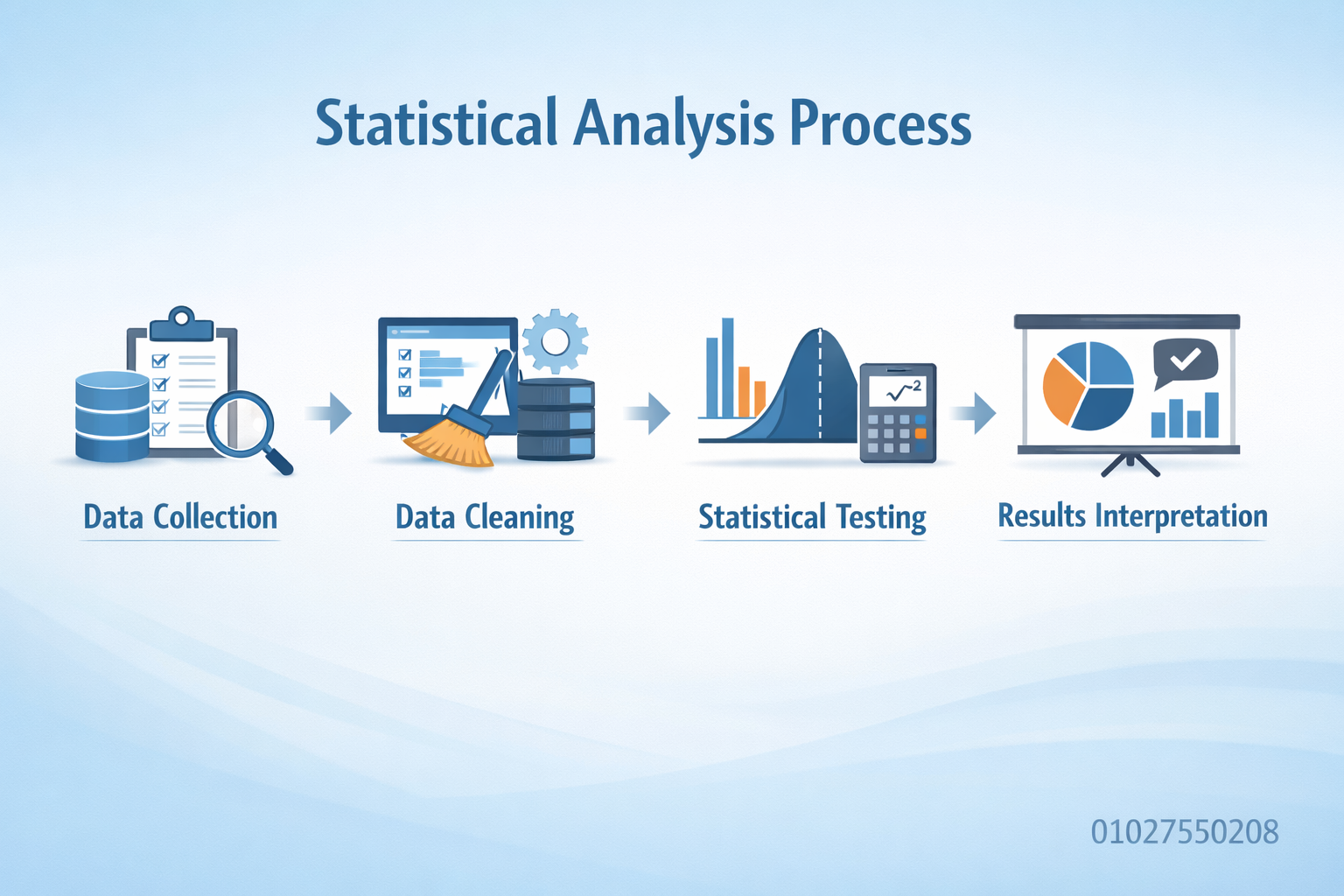
An illustration of the statistical analysis process:
Third section: Delving deeper into the interpretation of common statistical tests
To achieve research excellence, a researcher must deeply understand how to interpret the most popular statistical tests.
1. Interpreting the T-Test
A t-test is used to compare two averages. There are three main types:
|
T-test type“
|
Purpose
|
Null hypothesis (H0)
|
|
One sample
|
Compare the sample average to the average of a known population.
|
There is no difference between the sample mean and the population mean.
|
|
Two independent samples
|
Comparing the averages of two different groups (such as males and females).
|
There is no difference between the averages of the two groups.
|
|
Two related samples
|
Compare the averages of the same group before and after implementing a program.
|
There is no difference between tribal and dimensional scaling.
|
How to interpret:
1.Read Levene's Test: In the case of a t-test for two independent samples, you must first read Levene's test to determine whether the variance is equal between the two groups (Sig. > 0.05) or unequal (Sig. < 0.05). This determines which row you will use to read the t value and the Sig value.
2.Read the Sig. (P-value):
•If Sig. < 0.05we reject H0 and conclude that there is a statistically significant difference.
•If Sig. ≥ 0.05we do not reject H0 and conclude that there is no statistically significant difference.
3.Determine the direction of the difference: If there is a significant difference, return to the Means table to determine which of the two groups has a higher mean.
2. Interpretation of One-Way ANOVA
Univariate analysis of variance is used to compare the averages of three or more groups (such as comparing the performance of students at three different universities).
How to interpret:
1.Read the ANOVA table:
•The value of F: is the value of the test.
•Sig. (P-value): is the key to the decision.
2.Statistical decision:
•If Sig. < 0.05we reject H0 and conclude that there is a statistically significant difference between the means of the groups as a whole.
3.Post-hoc Tests: If the ANOVA result is statistically significant, it means that there is a difference somewhere, but it doesn't specify between which groups exactly. Here we use post-hoc tests (such as Tukey or Scheffé) to identify pairs of groups whose means are different from each other.
3. Correlation interpretation
Correlation is used to measure the strength and direction of the relationship between two quantitative variables. The most famous coefficient is Pearson's correlation coefficient (Pearson's r).
How to interpret:
1.The value of the coefficient (r): between -1 and +1.
•Proximity to +1: A strong reciprocal relationship (as one variable increases, so does the other).
•Proximity to -1: A strong inverse relationship (as one variable increases, the other decreases).
•Proximity to 0: A weak or non-existent relationship.
2.Sig. (P-value): Determines whether the detected relationship is statistically significant.
•If Sig. < 0.05The discovered relationship is not a coincidence.
4. Interpreting simple and multiple linear regression
Regression is used to predict the value of a dependent variable based on the value of one (simple) or more (multiple) independent variables.
Basic concepts in regression:
•The coefficient of determination (R-squared): Represents the percentage change in the dependent variable that is explained by the independent variable(s). The closer its value is to 1, the better the predictive model.
•Regression Coefficients (Beta Coefficients): It refers to the amount of change in the dependent variable per unit change in the independent variable. It determines the relative importance of each independent variable in the prediction.
•Sig. value. for each coefficient: Determines whether the effect of the independent variable on the dependent is statistically significant.
Photo of a researcher analyzing data:

Section IV: Challenges of interpreting results and how to overcome them
The process of interpretation is not free from challenges, and the professional researcher is the one who recognizes these challenges and deals with them consciously.
1. The challenge of statistical versus practical significance
The result may be “statistically significant” (P-value < 0.05), but it may not actually be significant.
•Example: You may find a statistically significant difference in the average scores of two groups, but the actual difference in the averages does not exceed one point, a difference that does not make a real change in educational practice.
•Solution: Using Effect Size measures such as Cohen's d Or Eta-squared. These measures determine the strength of the relationship or the size of the difference, regardless of the sample size.
2. Common Interpretation Errors (Type I and Type II errors)
|
Type of error
|
Definition
|
When does it happen?
|
|
Type I Error
|
The null hypothesis is rejected and is true.
|
When P-value < 0.05, but the detected difference was chance.
|
|
Type II Error
|
Do not reject the null hypothesis, which is false.
|
When the P-value is ≥ 0.05, but a true difference is not detected (often due to small sample size).
|
Dealing with mistakes: The researcher must balance between these two types of error. Minimizing α (such as using 0.01 instead of 0.05) reduces Type I error but increases Type II error.
3. The Problem of Statistical Assumptions
Most parametric statistical tests (such as T-test and ANOVA) require certain assumptions to be met (e.g. normal distribution of data, homogeneity of variance).
•Challenge: If these assumptions are not met, the test results may be unreliable.
•Solution:
•Perform hypothesis tests (such as the Shapiro-Wilk test for normal distribution).
•If the assumptions are not met, the Nonparametric statistical tests (Non-parametric tests as an alternative (e.g. Mann-Whitney test instead of T-test).
4. Interpreting Non-Significant Results
A researcher may find that all of their results are “statistically insignificant”. This does not mean that the research failed, but rather that the null hypothesis was not rejected.
•Correct interpretation: These results need to be bravely discussed, and logical explanations given for the lack of difference or relationship. It could be the nature of the sample, the accuracy of the instrument, or that the theoretical framework needs to be revised.
•Research value: Negative results have great scientific value, as they prevent other researchers from repeating the same path and guide them towards new research paths.
Section V: Advanced skills in writing the Results and Discussion chapter
1. Structuring the results chapter
The results chapter should be organized and logical, usually following the following order:
1.Sample metadata: Describe the demographic and social characteristics of the sample (gender, age, education).
2.Results of descriptive statistics for the variables: Display the means and standard deviations of the main variables.
3.View the results of hypothesis testing: Present the results of each hypothesis separately, starting with the null hypothesis, then the test value, degrees of freedom, P-value, and finally the statistical decision.
2. The art of discussing results
The discussion is the heart of the research, the stage where the researcher appears asCritical thinker.
•Linking to previous studies: Each key finding should be compared to previous studies.
•Agreement: If the result agrees, it should be backed up with a logical explanation.
•Difference: If the result differs, a convincing explanation must be provided and an attempt must be made to understand the reason for the difference (context, methodology, sample).
•Theoretical interpretation: The discussion should be rooted in the theories and concepts on which the research was based.
•Practical implications: The researcher must demonstrate how these findings can be applied in practice (in educational institutions, companies, or public policies).
3. Use tables and charts effectively
•Tables: It should be simple, clear, and self-explanatory. Don't repeat everything in the text that is in the table, but focus on the main points.
•Graphs: Use them to illustrate complex relationships or clear distinctions. Figures should be attractive and professional.
Toward more impactful scientific research
Mastering Interpreting the results of statistical analysis It is undoubtedly the defining skill that distinguishes an outstanding researcher from others. It is not just the end of a calculation, but the beginning of a deep intellectual process aimed at enriching knowledge and solving issues.
From understanding hypotheses to dealing with practical significance challenges, this guide provides the methodology needed to handle the output of statistical analysis with confidence and competence.
Science Club Academy We fully recognize the importance of this critical stage in the careers of researchers in Riyadh, Saudi Arabia and the UAE. We are here to provide specialized support, be it in conducting statistical analysis using the latest software, or in reviewing, auditing and in-depth interpretation of your results.
Don't let numbers get in the way of publishing your research. Contact us today to turn your data into powerful and compelling conclusions.
For specialized statistical consulting and support, contact us at




No comment